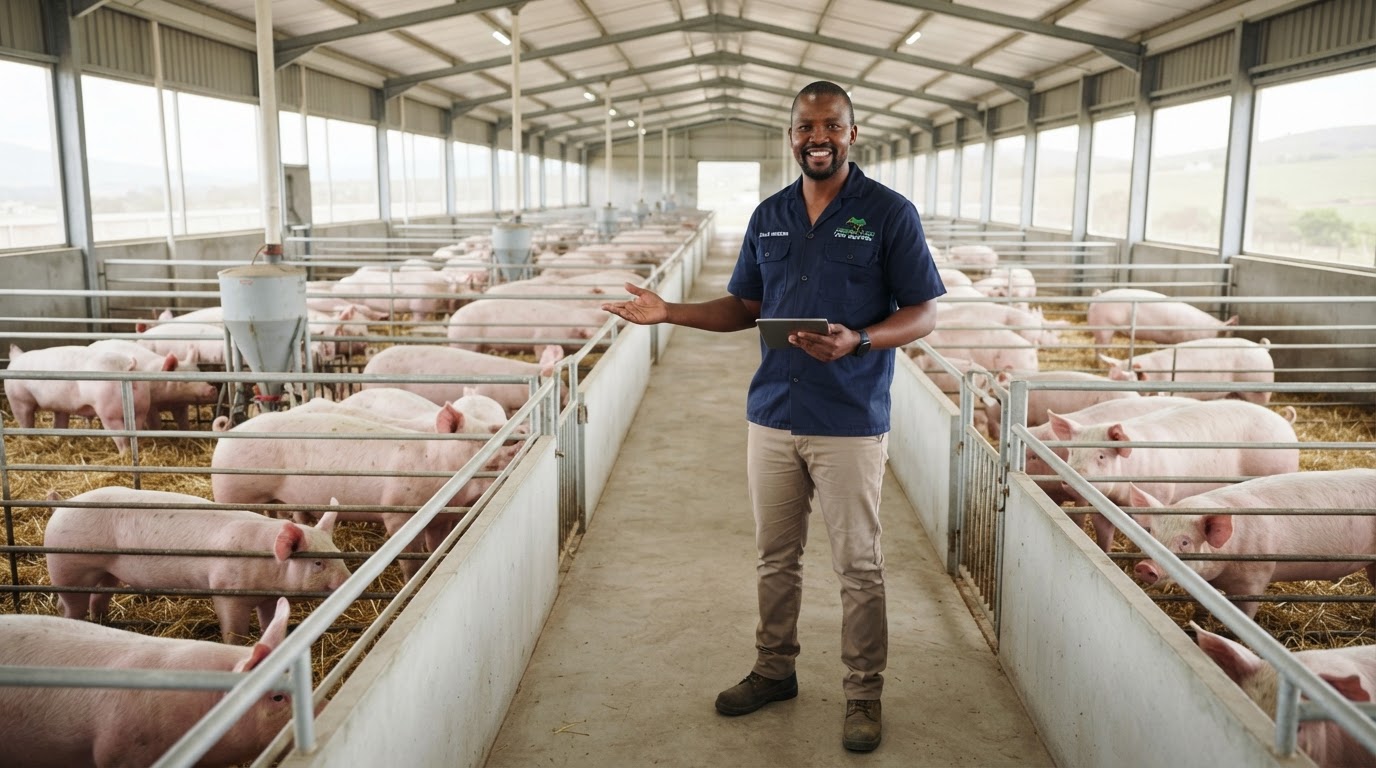
How to Start a 50-Pig Commercial Farm
A 50-pig fattening enterprise is a significant investment compared with a household piggery.
It may provide enough production volume to negotiate with feed suppliers and approach larger buyers. However, it also increases exposure to disease, cash-flow difficulties and market-price changes.
Before purchasing 50 pigs, farmers should demonstrate that they can successfully manage smaller batches and secure reliable buyers.
Step 1: Prepare a Commercial Production Plan
The first requirement is a clear business model.
For this article, the farm purchases 50 weaners weighing approximately 20 kg each and raises them to an intended live selling weight of 90 kg.
The farm therefore plans to produce:
50 × 90 = 4,500 kg of live pigs
This calculation assumes every animal survives and reaches target weight.
The farmer should verify whether local slaughterhouses and processors will accept 50 pigs together or prefer deliveries in smaller groups.
Step 2: Plan Housing and Infrastructure
A commercial piggery needs more than a large single enclosure.
Consider separate pens for incoming stock, growing pigs and animals requiring veterinary attention, while following veterinary guidance about isolation and movement controls.
The site should also accommodate feed storage, safe manure handling, water storage, equipment cleaning and a controlled entry point.
Illustrative initial infrastructure
Budge
Infrastructure component
                                      t
Housing, pen divisions and roofing $3,700
Feeders and watering system $600
Drainage and manure
                                      $600
management
Fencing and basic biosecurity $500
Water storage and cleaning
                                      $400
equipment
Total infrastructure $5,800
The figures are not construction quotations. The required standard may cost considerably more, particularly on a site requiring extensive drainage, road access, water treatment or strengthened disease-control boundaries.
Step 3: Calculate Feed Requirements
The FarmUP model assumes 224 kg of feed per pig.
For 50 pigs:
50 × 224 = 11,200 kg
At $0.32/kg: 11,200 × $0.32 = $3,584
A farm of this size needs appropriate storage capacity and reliable deliveries.
Avoid purchasing more feed than can be safely stored. Mouldy or contaminated feed can damage pig health and cause serious financial losses.
Step 4: Prepare the Operating Budget
Illustrative
Expense
                                      cost
50 weaners $2,250
Feed $3,584
Veterinary care and health
                                      $400
provisions
Water and utilities $200
Labour $500
Transport and marketing $400
Cleaning and miscellaneous $300
Total operating costs $7,634
Total first-cycle cash requirement:
$7,634+$5,800 = $13,434
This excludes land purchase, financing, depreciation and additional overheads.
Step 5: Estimate Commercial Sales Revenue
Assume every pig reaches 90 kg and sells at $2.20/kg liveweight.
Revenue:
4,500 × $2.20 = $9,900
Operating surplus: $9,900-$7,634 = $2,266
The first-cycle cumulative cash position, after paying the entire initial infrastructure budget, would be −$3,534.
The infrastructure is reusable, but the farm needs a realistic plan for maintenance, repairs, depreciation and recovery of the original investment.
Step 6: Evaluate Financial Risks
50-pig batch: operating surplus at different sale prices
Illustrative figures in USD, assuming 4,500 kg total liveweight sold and $7,634 operating costs.
$-1.5K$0$1.5K$3K$4.5K$1.60/kg$1.80/kg$2.00/kg$2.20/kg$2.50/kg
Every $0.10 change in sale price per kilogram changes modeled revenue by $450 for a 4,500 kg batch.
Similarly, every $0.05 increase in average feed price raises the batch’s feed expense by $560, assuming consumption remains 11,200 kg.
This shows why negotiating purchase costs and identifying reliable buyers are central to commercial piggery profitability.
Step 7: Manage Operations Professionally
Keep feed purchase records and monitor feed issued per pen.
Weigh representative pigs regularly to check whether growth is meeting expectations.
Assign clear responsibilities for daily inspection, feeding, water systems, cleaning, veterinary coordination and record keeping.
Prepare a contingency plan for water supply failure, feed shortages, transport disruption and suspected disease outbreaks.
A 50-pig operation should not depend on informal management or occasional supervision.
FAQs How much does it cost to start with 50 pigs?
The illustrative first-cycle cash requirement is $13,434, including housing and equipment. Actual investments may be substantially different.
How much operating surplus can 50 pigs generate?
The example produces $2,266 before depreciation, finance costs, taxes and other unmodeled costs, with no mortality and sales at $2.20/kg.
Is 50 pigs a suitable starting point for a beginner?
For many beginners, a smaller pilot is safer. A 50-pig project requires stronger financial reserves and operational management.