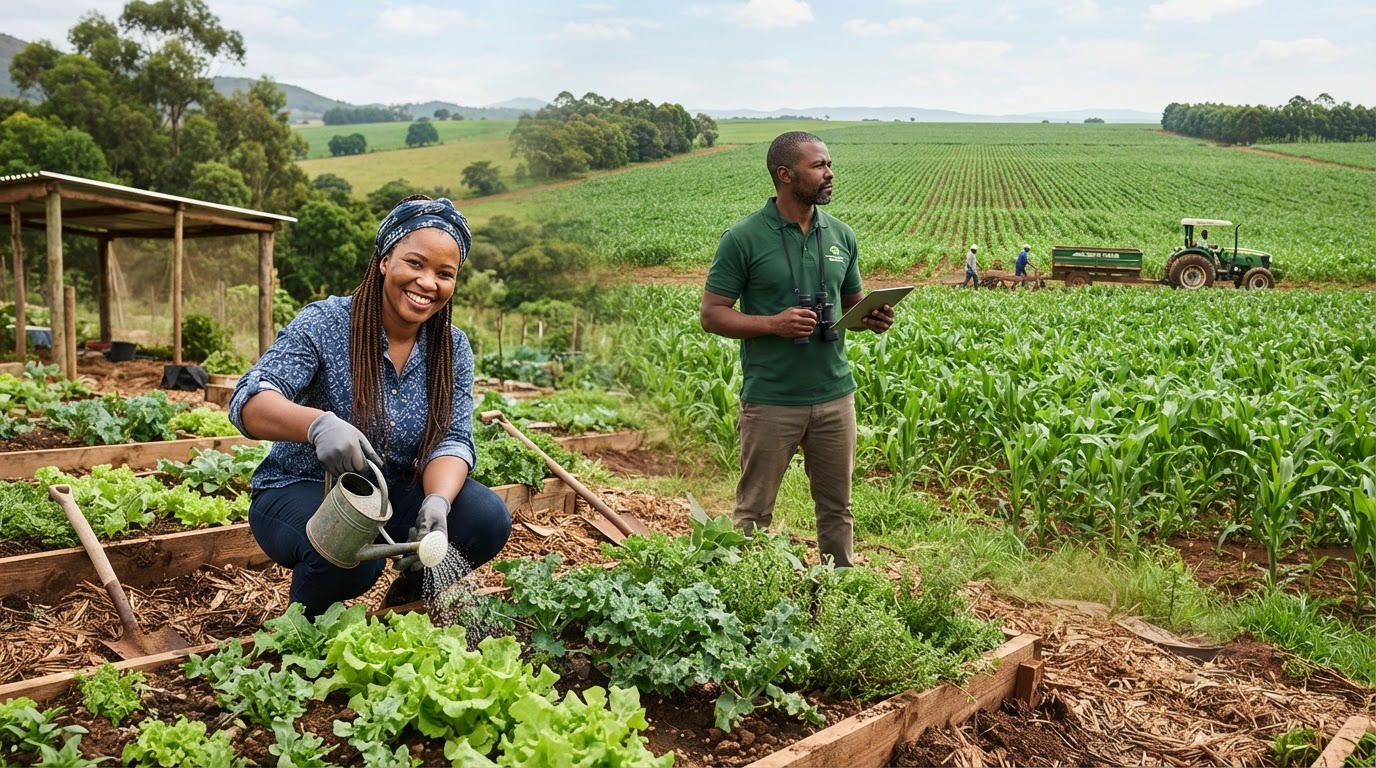
Choosing between small-scale farming and larger commercial agriculture is an important decision for aspiring farmers. Each approach has different capital requirements, production risks, management demands and market opportunities.
Starting small may allow beginners to develop experience with limited financial exposure, while larger commercial operations may benefit from production efficiencies and access to bigger markets.
What Is Small-Scale Farming?
Small-scale farming involves agricultural production using relatively limited land, labour, equipment and capital.
Small farms can operate commercially. The term describes production scale rather than whether the farmer sells agricultural products.
What Is Commercial Farming?
Commercial farming focuses on producing agricultural products for sale. It can range from a small backyard poultry project to a large mechanized agricultural enterprise.
For this comparison, larger-scale commercial farming refers to more capital-intensive production operations.
Small-Scale vs Larger Commercial Farming
| Factor | Small-scale farming | Larger commercial farming |
|---|---|---|
| Startup capital | Generally lower | Generally higher |
| Production volume | Limited | Higher |
| Labour | Owner or small team | Larger workforce |
| Equipment | Basic or semi-mechanized | Often mechanized |
| Markets | Local and direct sales | Wholesale and institutional |
| Management | Relatively simple | More complex |
| Financial exposure | Usually smaller | Potentially substantial |
| Expansion | Gradual | Requires structured investment |
Market Demand and Business Opportunities
Small farms may supply households, local vendors and restaurants. Larger farms may target supermarkets, food processors, exporters and institutional buyers.
Larger buyers frequently require consistent volumes, standardized quality and reliable delivery schedules.
Who Should Choose Small-Scale Farming?
Beginners, working professionals, entrepreneurs with limited capital and farmers testing new markets may benefit from starting with smaller production units.
Experienced farmers with established markets, reliable financing and technical expertise may consider larger-scale production.
Land, Climate and Water Requirements
| Farming activity | Small production unit | Larger example unit |
|---|---|---|
| Broilers | 100 birds | 1,000+ birds |
| Horticulture | 0.25 hectare | 5+ hectares |
| Layers | 100 birds | 2,000+ birds |
| Goats | 10 animals | 100+ animals |
| Maize | 1 hectare | 20+ hectares |
These are example production units, not official classifications.
Both small and large farms require locally appropriate crops, livestock breeds, reliable water and climate-risk management.
Startup Cost Comparison
Consider a 100-broiler project compared with a 1,000-broiler project.
| Startup item | 100 broilers | 1,000 broilers |
|---|---|---|
| Chicks | $100 | $1,000 |
| Feed | $280 | $2,800 |
| Housing | $180 | $2,000 |
| Equipment | $60 | $500 |
| Health supplies | $30 | $250 |
| Heating and bedding | $40 | $300 |
| Labour | $50 | $400 |
| Utilities and transport | $50 | $350 |
| Contingency | $60 | $600 |
| Total capital | $850 | $8,200 |
Equipment and Infrastructure
Small farms may operate using basic equipment, while larger operations may require automated feeding, ventilation, storage, backup electricity, transportation and dedicated management systems.
How to Choose the Right Farming Scale
Step 1: Evaluate Your Financial Capacity
Determine available startup capital and working capital.
Step 2: Assess Market Demand
Confirm that buyers can absorb your expected production.
Step 3: Evaluate Your Experience
Avoid expanding beyond your ability to manage production effectively.
Step 4: Consider Infrastructure
Ensure adequate water, electricity, housing, storage and transportation.
Step 5: Test Before Expanding
Use production records from smaller projects to guide expansion decisions.
Feeding, Fertilizer and Disease Management
Larger production systems may benefit from bulk purchasing, but disease outbreaks can affect more animals or crops simultaneously.
Maintain appropriate stocking densities, biosecurity procedures, soil testing and crop-specific nutrient management at every scale.
Production Timeline and Expected Yields
Assuming 95% of broilers placed reach market requirements:
- A 100-bird project produces 95 saleable birds.
- A 1,000-bird project produces 950 saleable birds.
Increasing production scale does not necessarily shorten the production cycle.
Revenue and Profit Comparison
Assumes a selling price of $6.50 per bird. Costs and prices are hypothetical.
Larger production units may reduce some costs per bird, but this advantage is not automatic.
Break-Even Analysis
| Project | Operating break-even price |
|---|---|
| 100 broilers | $5.79 per bird |
| 1,000 broilers | $5.37 per bird |
Infrastructure recovery, depreciation, financing and taxes are excluded.
Where to Sell
Small-scale farmers may prioritize direct customers. Larger operations should establish wholesale arrangements and investigate formal supply contracts.
Risks and Challenges
Larger operations face increased exposure to market fluctuations, disease outbreaks, staffing challenges and financing costs.
Small operations may struggle with higher unit costs and inconsistent production volumes.
How to Scale from Small to Commercial Farming
Increase capacity gradually, standardize production procedures, improve infrastructure and establish dependable buyers before expanding.
Frequently Asked Questions
Is small-scale farming profitable?
It can be, provided selling prices exceed all relevant production and business costs.
How much land is needed for commercial farming?
There is no universal minimum. Commercial production can take place on a small vegetable plot or a large agricultural estate.
Should beginners start with commercial farming?
Beginners may benefit from commercially oriented pilot projects before undertaking large investments.
Is larger farming always more profitable?
No. Larger operations can generate higher revenue while also experiencing substantial operating costs and losses.