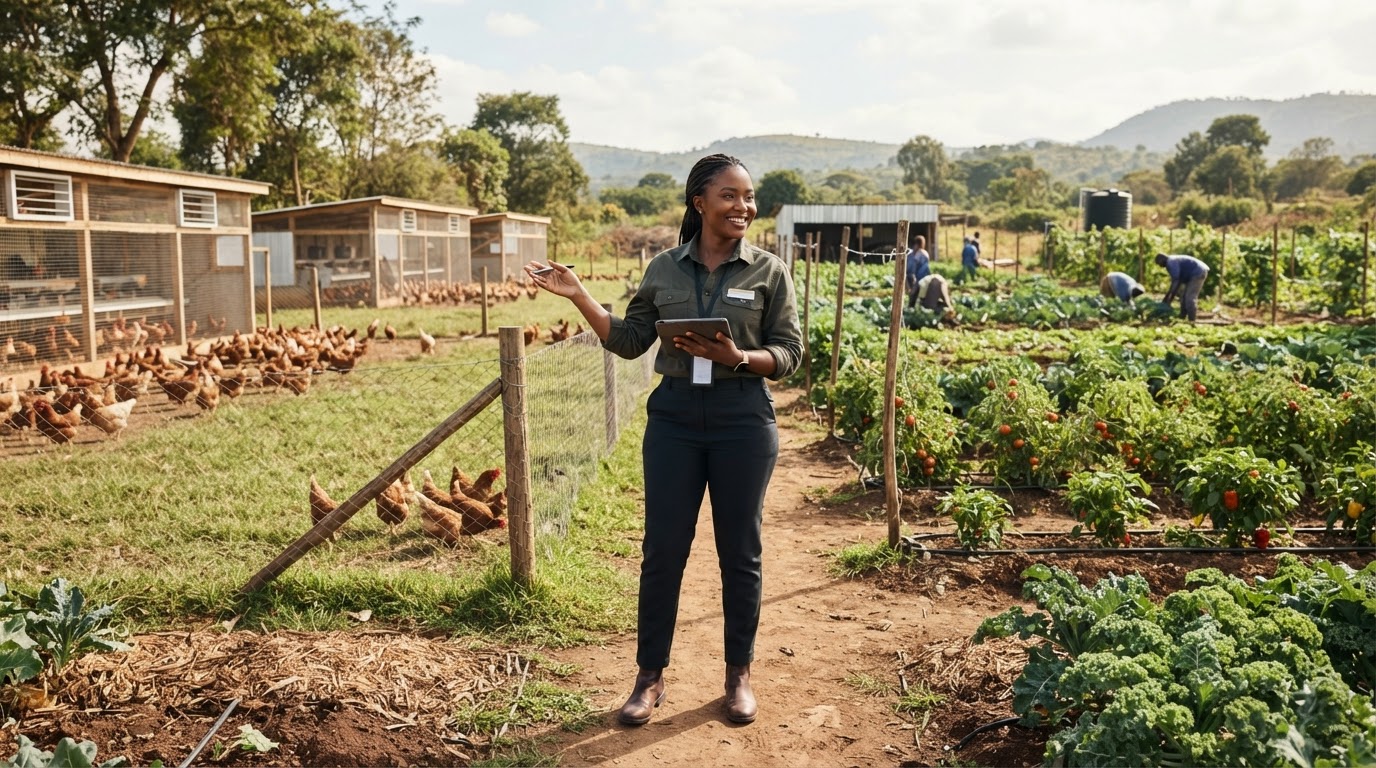
A $5,000 farming budget can provide opportunities to establish a more substantial agricultural enterprise. Farmers with access to suitable land, water and markets may consider commercial poultry, livestock production, irrigated horticulture or specialized agricultural projects.
However, larger investments also increase financial exposure. Detailed planning and conservative revenue projections remain essential.
Best Farming Businesses for a $5,000 Budget
| Farming business | Example production scale | Illustrative startup capital |
| Broiler farming | 500 birds | $3,000–$5,000 |
| Layer farming | 200 birds | $2,500–$5,000 |
| Piggery | 10–15 fattening pigs | $2,500–$5,000 |
| Goat farming | 15–20 goats | $2,000–$5,000 |
| Tomato farming | 0.5–1 hectare | $2,500–$5,000 |
| Onion farming | 0.5–1 hectare | $2,000–$5,000 |
| Greenhouse farming | 100–200 m² | $2,500–$5,000 |
| Tilapia farming | Small pond system | $2,000–$5,000 |
| Beekeeping | 15–25 hives | $1,500–$4,000 |
| Potato farming | 0.5 hectare | $2,000–$4,000 |
| Mushroom farming | Expanded production unit | $1,500–$4,000 |
| Mixed farming | Poultry and horticulture | $3,000–$5,000 |
Market Demand and Business Opportunities
A larger production unit requires customers capable of purchasing consistent volumes.
Investigate wholesale buyers, restaurants, supermarkets, food processors and agricultural distribution businesses before establishing production.
Who Is This Investment Suitable For?
This budget may suit experienced smallholders, agricultural entrepreneurs, working professionals with reliable farm management and farmers expanding an existing production system.
Land, Climate and Water Requirements
Irrigated horticulture requires a reliable water source, suitable soil and appropriate drainage.
Farmers in drought-prone African regions should evaluate water availability throughout the year before investing in commercial vegetable production.
High-rainfall areas require particular attention to drainage, fungal disease management and infrastructure protection.
Best Crops and Varieties
Commercial tomato, onion, cabbage and green pepper varieties may be suitable where market demand exists.
Select varieties based on climate suitability, disease resistance, shelf life, production requirements and buyer preferences.
Detailed Startup Budget: One-Hectare Tomato Farming
Total startup capital
$4,800
Unallocated capital from $5,000
$200
This model excludes land acquisition, borehole installation, major fencing and pump replacement.
Equipment and Supplies
A commercial tomato project may require irrigation lines, pumps where necessary, filters, nursery equipment, support stakes, harvesting crates, spraying equipment and protective clothing.
Step-by-Step Production Guide
Step 1: Secure Buyers
Research wholesale prices, quality requirements and seasonal market demand.
Step 2: Test Soil and Water
Evaluate soil fertility, drainage, water quality and irrigation capacity.
Step 3: Establish Irrigation
Install and test the water distribution system before transplanting.
Step 4: Purchase Suitable Seedlings
Choose healthy plants and locally appropriate commercial varieties.
Step 5: Manage Crop Nutrition and Growth
Follow soil-based fertilizer recommendations and appropriate crop support practices.
Step 6: Monitor Pests and Diseases
Implement integrated pest management and maintain accurate production records.
Step 7: Harvest and Sell
Grade tomatoes, use suitable containers and coordinate harvesting with buyer demand.
Fertilizer and Water Management
Tomatoes require balanced nutrition and consistent soil moisture.
Drip irrigation can help deliver water efficiently, while soil testing helps determine appropriate nutrient applications. Avoid excessive nitrogen and irregular irrigation.
Tomato Disease and Pest Management
Common threats include tomato leaf miner, bacterial wilt, early blight, late blight, whiteflies and viral diseases.
Use healthy planting materials, crop rotation, regular scouting, sanitation and locally registered crop protection products where appropriate.
Production Timeline and Expected Yields
Open-field tomatoes may begin producing marketable fruit approximately three to five months after sowing, with harvesting continuing according to variety and crop health.
The following scenarios model marketable yields of 12–30 tonnes per hectare. They are planning assumptions, not guaranteed or regionally verified averages.
Market Prices and Profit per Hectare
Assume $3,100 in base recurring expenses, excluding irrigation equipment, reusable support materials and unspent reserves. Allow additional harvesting and selling costs in higher-output scenarios.
| Financial indicator | Conservative | Typical model | Favourable |
| Marketable yield | 12,000 kg | 20,000 kg | 30,000 kg |
| Selling price/kg | $0.20 | $0.35 | $0.45 |
| Revenue | $2,400 | $7,000 | $13,500 |
| Operating expenses | $3,100 | $3,400 | $4,000 |
| Operating surplus | -$700 | $3,600 | $9,500 |
| First-cycle cash result* | -$2,100 | $2,200 | $8,100 |
*After $1,400 in irrigation and support-material expenditure. Higher-output scenarios may require additional working capital before sales are received.
Break-Even Analysis
At a marketable yield of 20,000 kg and operating expenses of $3,400, the operating break-even price is $0.17 per kilogram.
Including first-cycle infrastructure expenditure increases the cash break-even price to $0.24 per kilogram.
Where to Sell Tomatoes
Potential buyers include fresh produce markets, supermarkets, wholesalers, restaurants, food processors and agricultural distributors.
Risks and Challenges
Tomatoes are vulnerable to price fluctuations, perishability, disease outbreaks, water shortages and market oversupply.
Secure multiple buyers and avoid planting an entire commercial area without a marketing plan.
How to Scale the Business
Expand through staggered planting, improved irrigation, better storage, buyer agreements and production diversification.
Frequently Asked Questions
Is $5,000 enough to start commercial farming?
It may support a small commercial agricultural project where suitable land and water infrastructure already exist.
Which crop offers the highest profit with $5,000?
There is no universally highest-profit crop. Tomatoes, onions, peppers and other high-value vegetables may offer attractive opportunities under suitable conditions.
Can I start a 500-broiler project with $5,000?
Potentially, depending on housing, feed, equipment and labour costs.
Should I invest the entire $5,000 immediately?
Maintain adequate working capital and emergency reserves rather than committing all available funds to infrastructure.