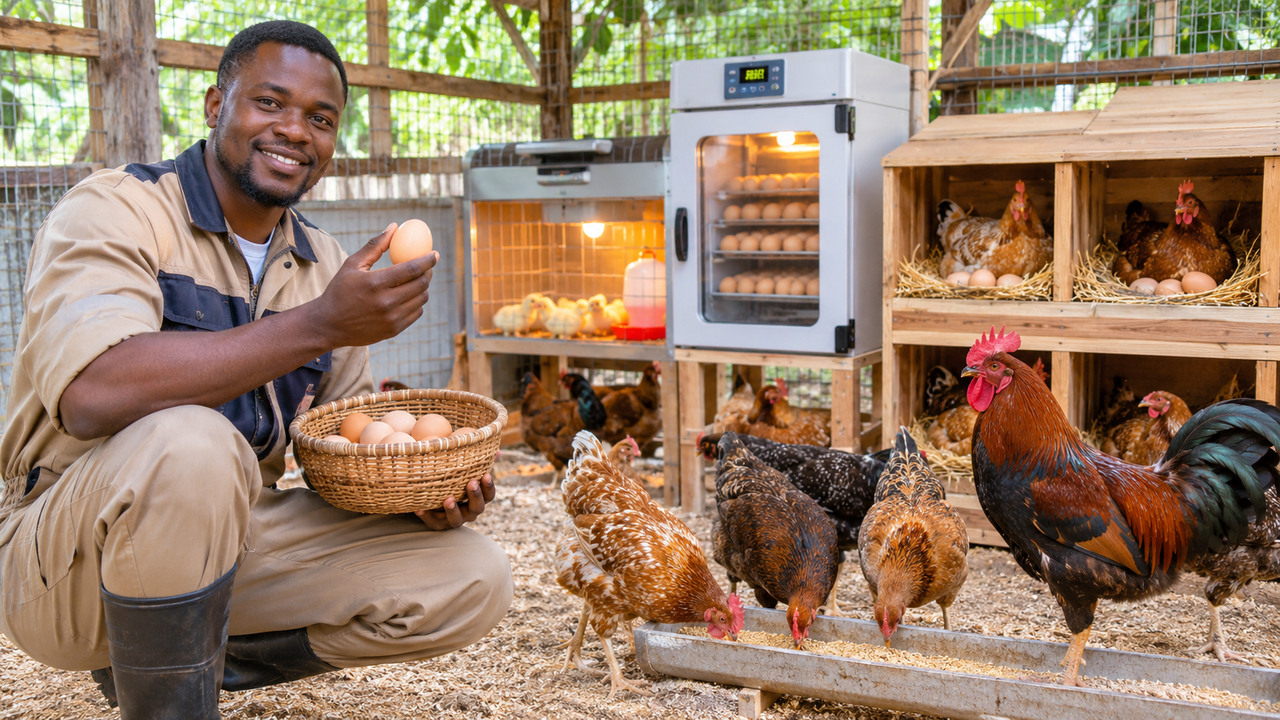
What Is an Indigenous Chicken Breeding Business?
Instead of raising every chicken for meat, a breeding farm produces fertile eggs, day-old chicks, growers or selected breeding birds for other farmers. This can create several income streams, but the business requires reliable reproduction, high-quality breeding stock, strong biosecurity and a market for the resulting chicks.
A hatchery should not be started simply because an incubator is available. Farmers first need dependable supplies of fertile eggs and buyers for the chicks.
Step 1: Choose a Breeding Objective
Select whether your farm will produce:
- Traditional indigenous chickens with characteristics valued by local buyers.
- Improved locally adapted chickens.
- Commercial dual-purpose chicks from authorised or reputable breeding sources.
- Fertile hatching eggs for other farms.
Do not advertise ordinary crossbred chicks as pure indigenous or branded commercial strains unless their parentage is documented.
Step 2: Select Healthy Breeding Stock
Choose birds with good body condition, sound legs, healthy plumage and no signs of disease.
Keep written records identifying individual breeding groups, laying performance, fertility and chick survival.
For natural mating, a commonly used starting arrangement is approximately one rooster for 8–10 hens, but the suitable ratio depends on breed, age, fertility and management.
Step 3: Plan Your Breeding Infrastructure
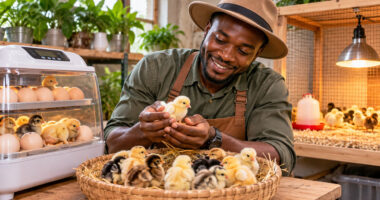
A small breeding enterprise needs separate accommodation for breeders, an egg collection and storage area, brooders and a sanitary space for incubation if artificial hatching is used. For natural incubation, nesting areas and suitable broody hens may be used, but output is less predictable.
Illustrative Breeding Unit Budget
Consider a pilot with 50 hens and 5 roosters purchased as breeding-age stock.
| Initial item | Illustrative cost |
|---|---|
| 50 hens at $10 | $500 |
| 5 roosters at $15 | $75 |
| Housing and fencing | $700 |
| Nests, feeders and drinkers | $120 |
| Small incubator and brooding equipment | $350 |
| Initial investment | $1,745 |
A hatchery also needs ongoing feed, egg handling, power, veterinary care,
packaging, labour and transport. Those costs are not included in the initial
$1,745.
The incubator capacity must match the number of suitable eggs collected, not simply the number of hens owned.
Example Hatchery Economics
Suppose 200 suitable eggs are set in one batch, with 75% hatchability of eggs set.
- Eggs set: 200.
- Chicks hatched: 150.
- Chick selling price: $2.
- Gross hatch revenue: $300. This is gross revenue, not profit. The cost of producing or purchasing eggs, incubator operation, unsold chicks, labour and equipment depreciation must still be deducted.
If each of the 200 eggs has a $0.35 opportunity cost, the egg input alone is $70.
A breeder must track both fertility and hatchability to identify problems.
Step 4: Establish a Breeding Record System
Record the age and source of breeders, eggs collected, eggs set, infertile eggs, hatch results, chick losses and sales.
Replace unproductive breeding stock and avoid uncontrolled mating among close relatives.
FAQs
Is selling day-old indigenous chicks profitable?
It can be, provided hatch rates, chick quality, demand and prices cover breeding and incubation costs.
Can a beginner start without an incubator?
Yes. Natural brooding or purchasing chicks from an established hatchery can be appropriate at small scale.
Can I hatch eggs bought from a supermarket?
Most supermarket table eggs are not intended for hatching and may be unfertilised or stored under unsuitable conditions.