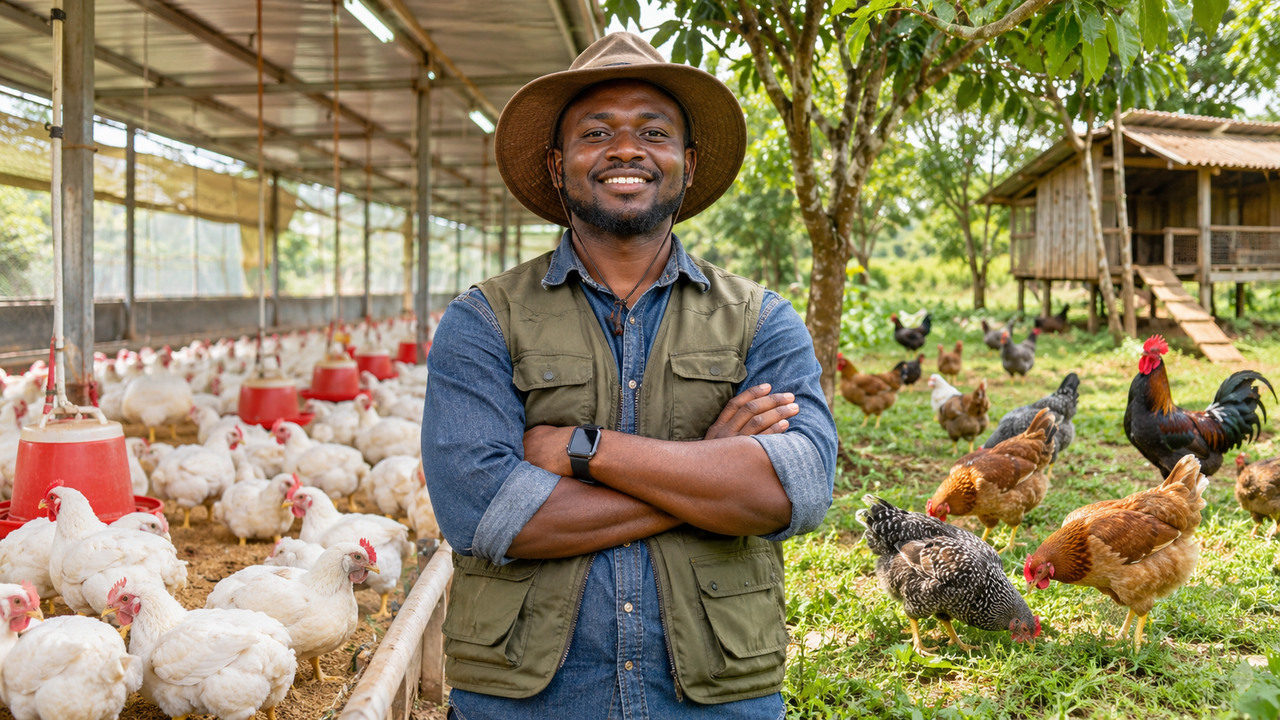
Which Is More Profitable: Free-Range or Broiler Chicken Farming?
Broiler farming and free-range chicken farming operate under different production models.
Commercial broilers are primarily selected for rapid meat growth, usually within a relatively short production cycle.
Traditional indigenous chickens and many improved dual-purpose chickens grow more slowly but may serve different consumer preferences and markets.
A higher selling price per indigenous chicken does not automatically mean higher profitability, because the birds may require substantially more time, feed and labour.
Comparison of Production Systems
| Feature | Commercial broilers | Free-range and indigenous chickens |
|---|---|---|
| Primary product | Poultry meat | Meat, eggs or breeding stock |
| Typical production period | Short | Usually longer, especially traditional birds |
| Feeding | Controlled commercial ration | Supplementary ration plus forage |
| Marketing | Broad conventional poultry market | Local, specialty or premium segments |
| Housing | Controlled environment or intensive system | Secure house plus outdoor access |
| Main risks | Feed costs, disease, heat and price competition | Mortality, predation, slow growth and inconsistent pricing |
Financial Comparison: 100 Birds
The broiler figures below use the illustrative model from FarmUP’s Broiler Chicken Cluster. The free-range model uses the assumptions in Articles 52 and 54.
| Financial measure | 100 broilers | 100 free-range chickens |
|---|---|---|
| Chicks purchased | 100 | 100 |
| Expected surviving birds | 95 | 90 |
| Production period | About 42 days | About 112 days |
| Initial infrastructure | $380 | $650 |
| Operating costs | $511.40 | $722 |
| First-cycle cash requirement | $891.40 | $1,372 |
| Modeled revenue | $578.55 | $900 |
| Operating surplus | $67.15 | $178 |
These are planning scenarios, not predictions of actual market performance. The broiler model assumes live-weight sales, while the free-range model assumes sales per bird. Feed consumption, selling prices and labour estimates come from different hypothetical production systems.
Why Production Time Matters
A free-range cycle lasting 112 days occupies housing and working capital for considerably longer than a 42-day broiler cycle.
A simple operating-surplus-per-day comparison illustrates the difference:
| Measure | Broilers | Free-range chickens |
|---|---|---|
| Modeled operating surplus | $67.15 | $178 |
| Cycle days | 42 | 112 |
| Average surplus per calendar day | $1.60 | $1.59 |
These daily equivalents are not guaranteed daily income and do not account for turnaround time, unsold inventory or the number of production cycles achievable in a year.
They show why cash-flow speed and capital turnover matter as much as profit per batch.
When Broiler Farming May Be Better
Broilers may suit farmers who have dependable feed suppliers, suitable housing, fast-growing-bird expertise and buyers who need regular conventional chicken deliveries.
Broilers also allow more frequent production cycles, although each cycle still carries exposure to disease, feed cost changes and price fluctuations.
When Free-Range Farming May Be Better
Free-range production may suit farmers who have secure outdoor space, access to reliable breeding stock and buyers willing to pay for a particular local or slow- growing type of chicken.
Traditional indigenous breeding can also create opportunities for egg and chick sales, although it requires different financial modeling from meat production.
Practical Decision Checklist
Before choosing either enterprise, obtain actual quotations for chicks, feed, housing and veterinary services.
Then ask buyers for confirmed price offers and compare:
- Operating surplus per batch. Working capital required.
- Length of each cycle.
- Expected annual capacity.
- Mortality risk.
- Sale price sensitivity.
- Time required to recover infrastructure costs.
FAQs
Are free-range chickens always more expensive than broilers?
Not always. Prices depend on location, breed, size, season and buyer demand.
Which farming system is easier for beginners?
Both require daily management. Small broiler batches may be faster to evaluate, while free-range projects may suit farmers with more outdoor space and longer production horizons.
Can a farmer raise broilers and indigenous chickens together?
Both enterprises can operate on one property, but separate housing, age groups, equipment and strong biosecurity are important.