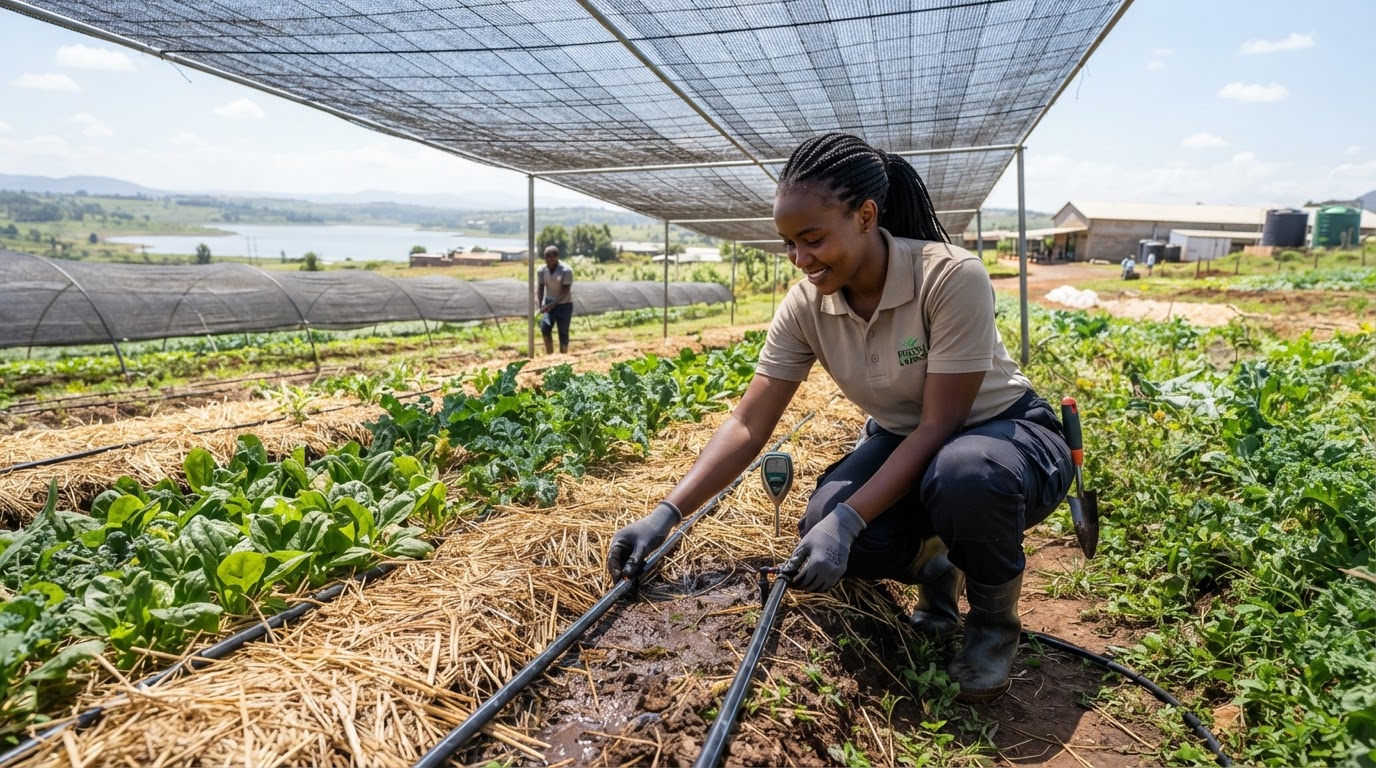
Climate variability presents significant challenges for African agricultural businesses. Delayed rainfall, drought, flooding, heatwaves and unpredictable growing seasons can affect crop yields, livestock health and farm profitability.
Climate-smart farming focuses on agricultural practices that improve productivity, strengthen resilience and, where possible, reduce agriculture-related greenhouse gas emissions.
What Is Climate-Smart Agriculture?
Climate-smart agriculture is an approach to agricultural development built around three broad objectives:
Improving agricultural productivity and livelihoods.
Strengthening adaptation and resilience to climate change.
Reducing or avoiding greenhouse gas emissions where feasible.
It is not a single farming method. Appropriate practices depend on local environmental, economic and agricultural conditions.
Climate Risks Facing African Farmers
| Climate risk | Potential agricultural impact |
| Delayed rainfall | Late planting and shorter growing seasons |
| Drought | Reduced yields and water shortages |
| Flooding | Crop damage, erosion and livestock losses |
| Heatwaves | Crop stress and reduced animal productivity |
| Unpredictable rainfall | Production scheduling difficulties |
| Increased pest pressure | Higher crop protection expenses |
| Water scarcity | Limited irrigation capacity |
| Soil degradation | Reduced productivity and resilience |
Market Demand and Climate-Smart Opportunities
Climate-resilient agricultural businesses may benefit from improved production consistency and reduced exposure to weather-related losses.
Opportunities include drought-tolerant crop production, water-efficient horticulture, agricultural seedling businesses, solar-powered irrigation and climate-adapted livestock production.
Commercial viability must still be evaluated against startup costs and market demand.
Who Should Adopt Climate-Smart Farming?
Climate-smart practices are relevant to smallholders, commercial farmers, livestock producers, agricultural entrepreneurs and farmers operating in drought-prone or flood-prone regions.
Land, Climate and Water Requirements
Farmers should assess local rainfall trends, soil moisture retention, water availability, drainage, erosion risks and exposure to extreme temperatures.
Climate adaptation strategies should be designed around these specific risks.
Best Climate-Smart Farming Practices
| Farming practice | Potential benefit |
| Drought-tolerant varieties | Reduced exposure to moisture stress |
| Crop diversification | Reduced dependence on one crop |
| Mulching | Improved soil moisture conservation |
| Cover cropping | Soil protection and improved ground cover |
| Crop rotation | Improved soil and pest management |
| Minimum tillage | Reduced unnecessary soil disturbance |
| Rainwater harvesting | Additional water availability where feasible |
| Drip irrigation | Efficient water application |
| Agroforestry | Potential shade, soil and diversification benefits |
| Staggered planting | Reduced dependence on one planting date |
| Improved livestock housing | Better protection against weather stress |
| Weather-informed planning | Improved production timing |
Climate-Smart Farming Startup Budget
Illustrative one-hectare adaptation programme for an existing farm.
| Investment | Estimated cost |
| Drought-tolerant seed allowance | $100 |
| Soil testing | $50 |
| Mulching and cover crop materials | $120 |
| Organic soil amendments | $150 |
| Basic supplementary irrigation equipment | $300 |
| Rainwater collection improvements | $200 |
| Drainage and erosion control | $120 |
| Training and weather information | $40 |
| Labour | $120 |
| Emergency reserve | $100 |
| Total adaptation budget | $1,300 |
This is an adaptation investment rather than a complete farming startup budget. It assumes existing farmland and access to an appropriate supplementary water source.
Equipment and Supplies
Climate-smart production may require rain gauges, irrigation equipment, soil moisture monitoring tools, water storage facilities, shade structures and locally adapted planting materials.
Farmers should prioritize affordable technologies that address actual production constraints.
How to Implement Climate-Smart Farming
Step 1: Identify Your Main Climate Risks
Determine whether drought, flooding, heat stress, rainfall variability or other conditions pose the greatest threat.
Step 2: Select Suitable Crops and Breeds
Choose locally adapted varieties and livestock breeds according to production conditions and market demand.
Step 3: Improve Soil Health
Use appropriate organic matter management, crop rotation and soil protection practices.
Step 4: Strengthen Water Security
Investigate sustainable irrigation, rainwater harvesting and soil moisture conservation.
Step 5: Diversify Production
Avoid relying entirely on one crop, one livestock enterprise or one production season.
Step 6: Use Weather Information
Monitor seasonal forecasts and short-term weather updates to support planting, irrigation and harvesting decisions.
Step 7: Measure Financial Performance
Compare production costs, marketable yields and losses before and after adopting new practices.
Climate-Smart Farming Strategies by Region
| African region | Potential adaptation priorities |
| Southern Africa | Drought-tolerant crops, supplementary irrigation and moisture conservation |
| East Africa | Rainfall-informed planting, water harvesting and highland erosion management |
| West Africa | Short-duration crops, drought adaptation and seasonal diversification |
| Central Africa | Drainage, erosion control and tropical disease management |
| North Africa | Water efficiency, salinity management and heat-adapted production |
Fertilizer and Water Management
Climate-smart nutrient management aims to match fertilizer applications with crop requirements and soil conditions.
Water management should balance agricultural productivity with long-term water availability and environmental sustainability.
Climate-Related Disease and Pest Management
Changing weather conditions may alter pest distribution and disease pressure.
Farmers should monitor fall armyworm, locusts, aphids, fungal diseases, livestock parasites and other locally relevant threats.
Use integrated pest management, healthy planting materials, veterinary guidance and appropriate biosecurity practices.
Climate-Smart Livestock Farming
Livestock farmers can improve climate resilience through appropriate shade, ventilation, clean drinking water, fodder reserves, suitable breeds and planned grazing systems.
Poultry and piggery projects require particular attention to heat stress and reliable water supplies.
Production Timeline and Expected Yields
Climate adaptation benefits vary by practice. Improved planting decisions may influence the current growing season, while soil health improvements may require several seasons.
Financial Comparison: Conventional vs Climate-Adapted Farming
Assume a one-hectare maize farm operating under three hypothetical weather scenarios.
| Weather scenario | Conventional yield | Climate-adapted yield |
| Severe dry season | 800 kg | 1,500 kg |
| Moderate season | 2,200 kg | 3,000 kg |
| Favourable season | 4,000 kg | 4,500 kg |
Conventional production
Climate-adapted production
Market Prices and Profit Analysis
Assume a selling price of $0.30 per kilogram, conventional operating expenses of $630 and climate-adapted operating expenses of $750.
| Weather scenario | Conventional surplus | Climate-adapted surplus |
| Severe dry season | -$390 | -$300 |
| Moderate season | $30 | $150 |
| Favourable season | $570 | $600 |
The climate-adapted model reduces losses under the assumed severe dry-season conditions but does not eliminate them. Initial adaptation infrastructure costs are excluded from these operating results.
Break-Even Analysis
If a climate adaptation practice costs an additional $120 per season and the crop sells for $0.30 per kilogram, it must preserve or generate at least 400 kg of additional marketable production to recover its recurring cost.
Capital investment recovery requires a separate payback calculation.
Where to Access Climate Information
Farmers can obtain weather information from national meteorological services, agricultural extension departments, regional climate centres and agricultural research institutions.
Risks and Challenges
Climate-smart farming may require additional investment, training and management. Some practices may not deliver sufficient financial benefits under local conditions.
Avoid investing in expensive technologies without evaluating their suitability and expected returns.
How to Scale Climate-Smart Farming
Begin with affordable, locally appropriate practices. Monitor their performance, retain successful approaches and gradually expand investments according to measured agricultural and financial benefits.
Frequently Asked Questions
What is climate-smart farming?
It is an agricultural approach focused on productivity, climate resilience and reducing environmental impacts where feasible.
What crops are suitable for unpredictable rainfall?
Sorghum, millet, cowpeas and locally adapted early-maturing crop varieties may be suitable.
Can small-scale farmers afford climate-smart agriculture?
Some practices, including crop rotation, mulching and improved planting decisions, may require relatively limited additional investment.
Does climate-smart farming guarantee higher profits?
No. Financial results depend on climate conditions, implementation costs, production performance and market prices.
How can farmers protect livestock during heatwaves?
Provide appropriate shade, ventilation, sufficient clean drinking water and locally recommended heat-stress management.