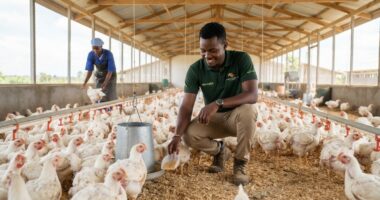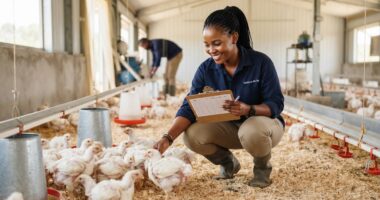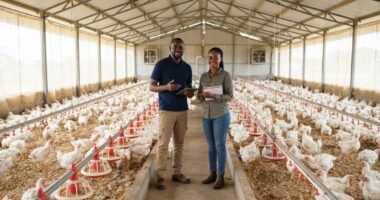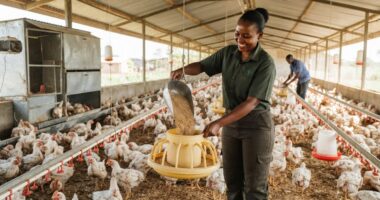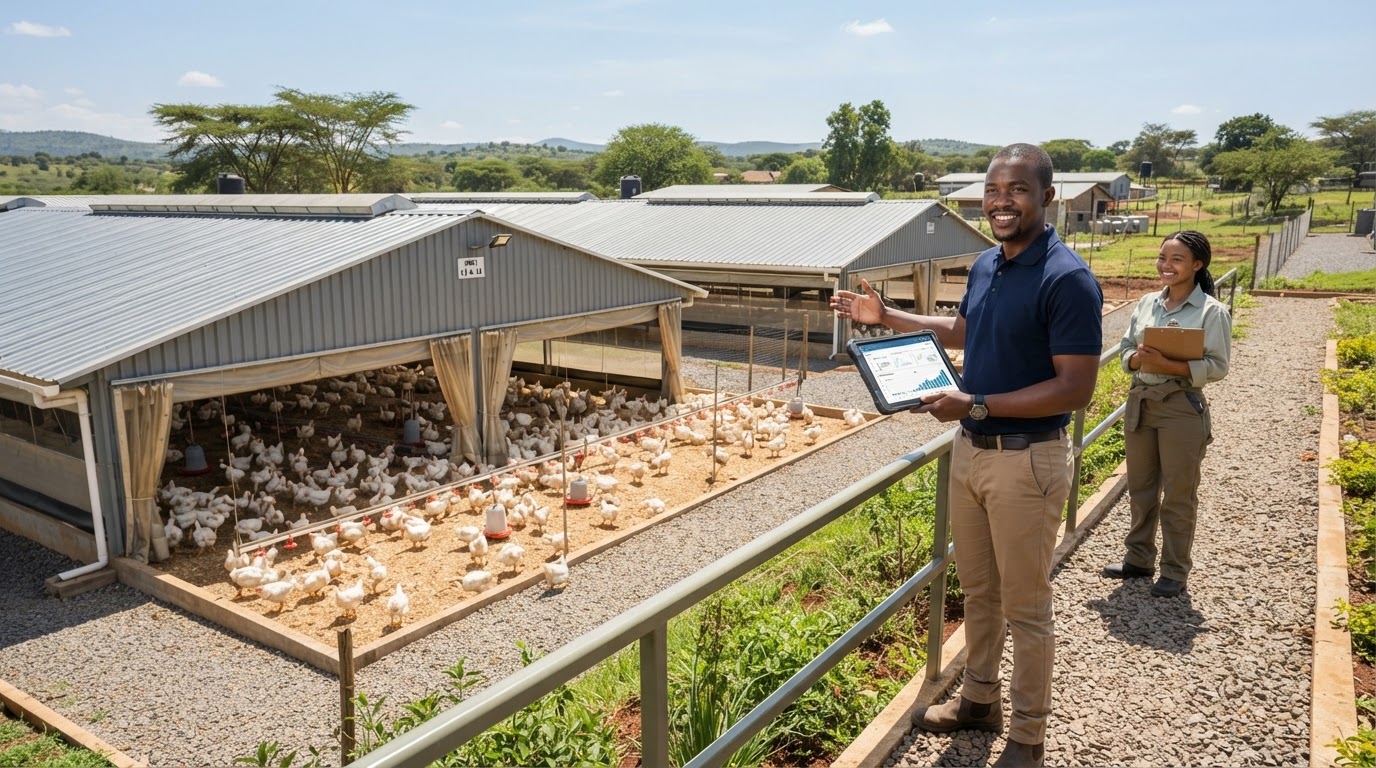
A 500-broiler enterprise is a significant step beyond backyard farming. It requires more working capital, increased feed storage, dependable water supplies, disciplined stock management and a plan for selling hundreds of chickens within a short period.
Before expanding, farmers should calculate whether the larger operation improves their economics sufficiently to justify the financial exposure.
How Much Capital Do You Need for 500 Broilers?
Here is a hypothetical budget based on the same assumptions used throughout Cluster 4.
Illustrative
Expense
                              USD
500 day-old chicks $550
Feed: 2,100 kg $882 Water and energy $130
Veterinary and health
                             $85
provision
Litter $80
Transport and marketing $150
Labour $180
Miscellaneous $90
Total recurring operating
                             $2,147
cost
Poultry-house construction $1,600
Equipment and supplies $350
Total first-cycle capital $4,097
A contingency reserve should be added to this budget. For example, reserving 10% of estimated operating expenses would add approximately $215.
Housing for 500 Chickens
At a provisional 10 birds per square metre, a flock of 500 requires about 50 m² of usable floor area, plus an appropriate arrangement for equipment and operations.
Space must be adjusted for market weight, heat, airflow, welfare and applicable regulations.
Position the house on well-drained ground, fit bird-proof mesh, protect the roof from leaks and establish a safe cleaning area. In hot regions, reducing stocking density may be necessary to limit heat stress.
Feeding Plan for 500 Broilers
For a planning intake of 4.2 kg per chick placed: 500×4.2 = 2,100 kg
That equals 42 bags of 50 kg feed.
The exact quantities of starter, grower and finisher ration depend on the selected commercial feeding programme. Farmers should compare the supplier’s age- specific feeding instructions with the flock’s actual consumption and growth.
Expected Revenue
Under the typical model:
- 500 chicks placed
- 5% mortality
- 475 chickens sold
- Average weight: 2.1 kg
- Price: $2.90 per kilogram of liveweight
Revenue equals:
475×2.1×$2.90 = $2,892.75
Operating surplus:
$2,892.75 − $2,147 = $745.75
This amount is before depreciation, financing, taxes and other excluded expenses.
Three Profit Scenarios
Operating
Scenario                            Revenue
                                              surplus/(loss)
Conservative: 450 × 1.9 kg ×
                                    $2,137.50 −$9.50
$2.50
Typical: 475 × 2.1 kg × $2.90       $2,892.75 $745.75
Favourable: 485 × 2.3 kg ×
                                  $3,569.60 $1,422.60
$3.20
The operating budget is held constant in these comparisons; actual expenses may change with performance and market conditions.
Break-Even Price
At the typical saleable weight of 997.5 kg:
($2,147 ÷ 997.5) = $2.15/kg
To recover the full $4,097 first-cycle cash outlay from that one flock, the selling price would need to be much higher, about $4.11/kg. That does not mean the business must recover all reusable infrastructure in its first cycle; a farm normally allocates its investment across several production cycles.
How to Sell 500 Chickens
At this scale, individual household sales alone may be difficult to coordinate.
Build a buyer pipeline ahead of the harvest, combining butcheries, traders, restaurants, institutions and direct consumers. Agree on payment timing and whether prices are per live bird, live kilogram or dressed kilogram.
Risks
The major risks are unsold mature birds consuming additional feed, falling prices, poor ventilation, unreliable water, disease and late customer payments.
FAQs
Is 500-broiler farming profitable?
It can be, but the illustrative model produces anything from a small operating loss to a substantial surplus depending on mortality, weight and price.
How many bags of feed are required?
The planning model uses 42 bags of 50 kg feed for 500 chicks placed.
Can one person manage 500 broilers? One competent person may handle many routine tasks, but backup labour and supervision are important during brooding, cleaning, delivery and emergencies.
Should beginners start with 500 birds?
A smaller pilot is generally preferable unless the farmer already has poultry management experience and reliable buyers.