How Long Do Chicken Eggs Take to Hatch?
Chicken eggs generally take approximately 21 days to hatch under appropriate incubation conditions.
Successful hatching depends on egg fertility, handling, incubation temperature, humidity, turning, sanitation and the condition of the parent flock.
Artificial incubation allows a farmer to hatch more eggs without depending entirely on broody hens, but it introduces equipment and power requirements.
Step 1: Collect Suitable Hatching Eggs
Use eggs from healthy, appropriately fed and fertile breeder flocks.
Select reasonably clean, normally shaped eggs with intact shells. Avoid severely soiled, cracked or unusually shaped eggs.
Collect regularly and keep eggs in appropriate storage conditions. Do not wash hatching eggs casually, as poor washing practices can increase contamination risk.
Step 2: Prepare the Incubator
Clean and disinfect the incubator according to the manufacturer’s guidance. Check temperature, humidity, ventilation, automatic turning and any backup power source before loading the eggs.
Many forced-air chicken incubators operate around 37.5°C, but the manufacturer’s specifications and the actual measurement position matter. Still- air models may need different settings.
Step 3: Turn Eggs During Incubation
Chicken eggs need regular turning during most of incubation to support embryo development.
Automated incubators normally manage this function. For chicken eggs, turning is generally stopped around day 18 as the eggs enter the final hatch period.
Follow the equipment supplier’s specific procedure rather than applying one universal setting to every incubator.
Step 4: Monitor Development
Candling allows the operator to assess whether an egg shows embryo development and to identify some unsuccessful eggs.
Handle eggs gently and maintain hygiene.
Dispose of rotten or leaking eggs safely, without allowing them to contaminate other eggs.
Step 5: Transfer Chicks to a Brooder
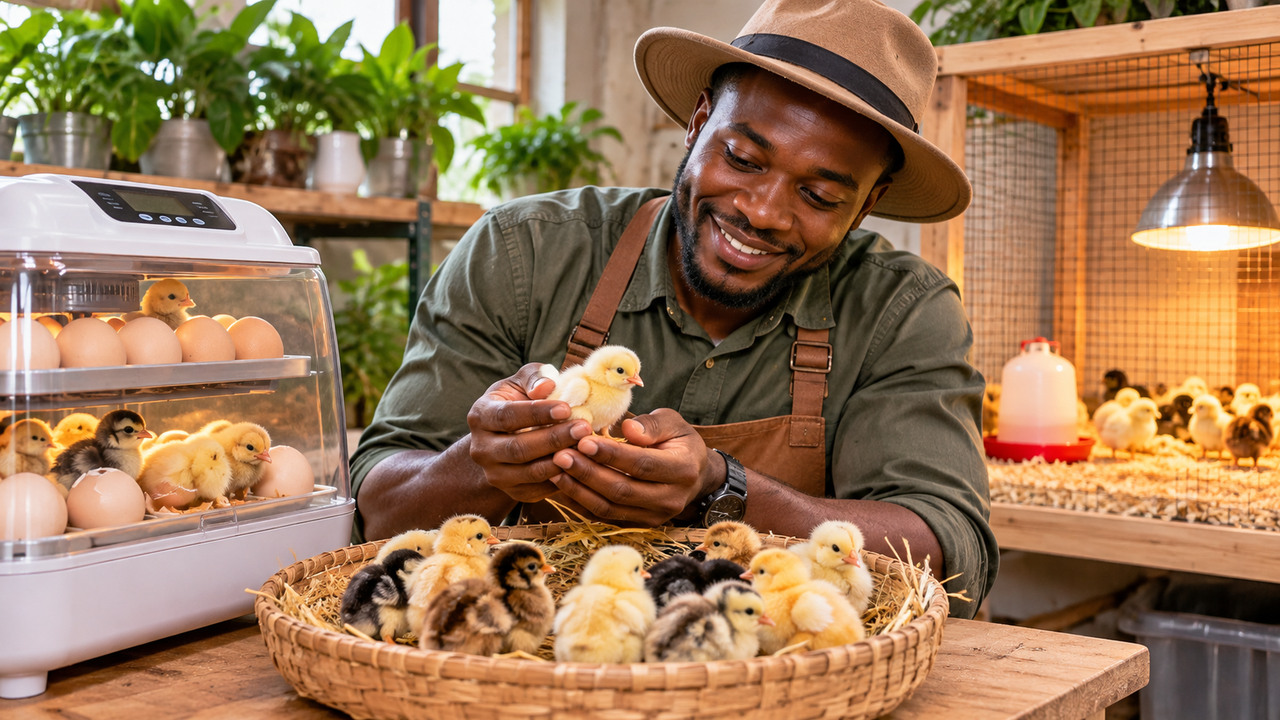
After hatching, allow healthy chicks to dry appropriately before transfer to clean, pre-warmed brooding accommodation.
Provide chick starter feed, clean water and a temperature gradient so birds can move between warmer and cooler areas.
Watch chick behaviour. Birds huddling near the heat source may be cold, while those avoiding it may be overheated.
Hatchery Performance Example
| Metric | Example |
|---|---|
| Eggs set | 100 |
| Fertile eggs | 85 |
| Chicks hatched | 75 |
| Fertility | 85% |
| Hatchability of eggs set | 75% |
| Hatchability of fertile eggs | 88.2% |
These are illustrative numbers, not promised hatch rates.
If a hatchery consistently performs poorly, investigate parent-stock nutrition, fertility, egg storage, incubation calibration and hygiene before purchasing more equipment.
FAQs
Can I hatch chicken eggs without electricity?
Natural incubation by broody hens is possible. Artificial incubation requires an appropriate energy and temperature-control solution.
Why do some eggs fail to hatch?
Possible causes include infertility, poor egg storage, unsuitable incubation conditions, contamination or problems with parent-stock health.
When should chicks start eating?
Newly hatched chicks should receive prompt access to suitable feed and clean water according to accepted brooding practice.