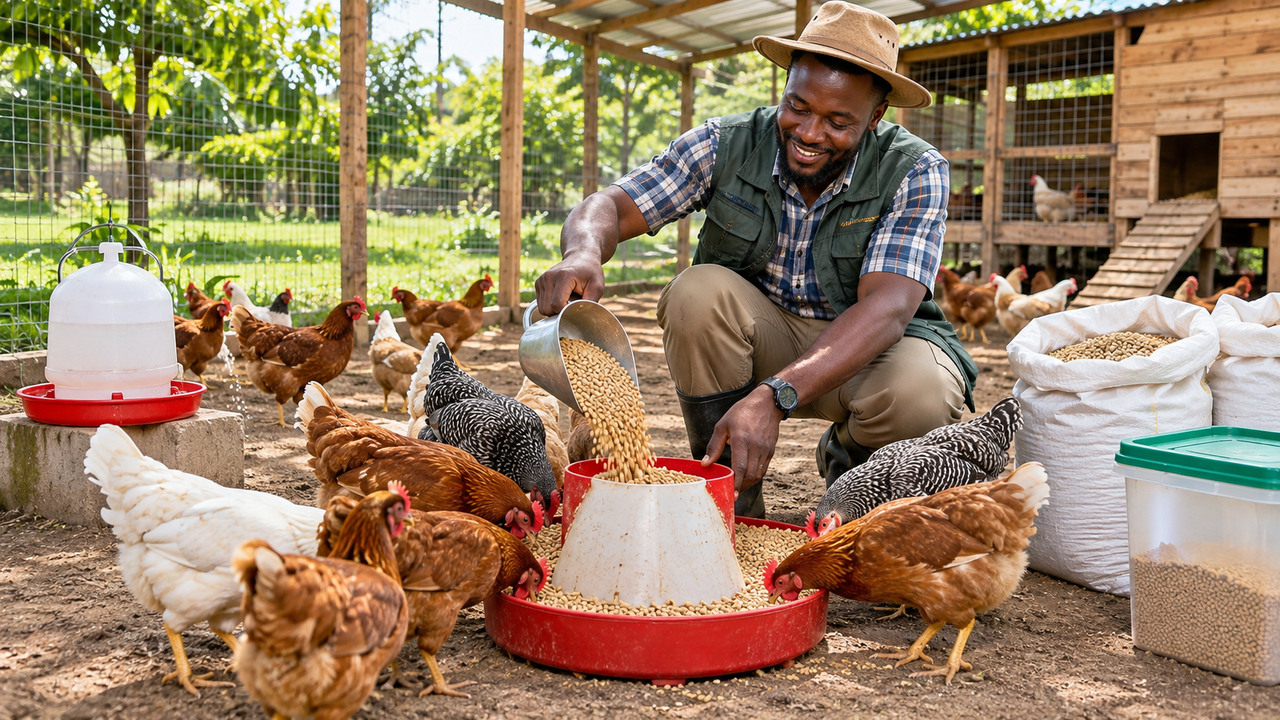
What Should Free-Range Chickens Eat?
Free-range chickens eat insects, seeds, green plants and other forage, but these foods do not consistently supply all the nutrients required for commercial growth, egg production and reproduction.
A productive free-range chicken farming business therefore needs an organised supplementary feeding programme.
The nutritional needs of a newly hatched chick differ from those of a growing cockerel or a laying hen. Feeding Chickens by Growth Stage
| Production stage | Nutritional priority | Suitable feeding approach |
|---|---|---|
| Newly hatched to early brooding | High-quality protein, energy and essential nutrients | Commercial or professionally formulated chick starter |
| Growing birds | Balanced growth, muscle and skeletal development | Appropriate grower ration |
| Birds approaching meat sale | Efficient finishing without unnecessary waste | Suitable grower/finisher ration |
| Laying hens | Energy, protein, calcium and minerals | Formulated layer ration |
| Breeding birds | Reproduction, fertility and body condition | Balanced breeder ration appropriate to the flock |
Exact ages, feed changes and nutrient specifications depend on the breed and feeding programme.
Can Local Feed Ingredients Reduce Costs?
Farmers may have access to maize, sorghum, millet, sunflower cake, soybean meal, bran or other local ingredients.
These ingredients can contribute nutrients, but mixing them without a formulation can create serious deficiencies or imbalances.
For example, maize supplies energy but does not provide sufficient balanced protein, vitamins and minerals by itself.
A local livestock nutritionist or qualified feed supplier can recommend a ration using ingredients available in the region.
How Much Feed Do Free-Range Chickens Need?
For the illustrative 100-bird model, the total supplementary feed budget is 600 kg across 16 weeks.
This is a project assumption, not a universal feeding standard. Record actual feed by week and compare it with growth. A flock taking longer to reach sale condition may consume substantially more feed than budgeted.
Feeding Practices That Protect Profit
1. Feed at consistent times and maintain unrestricted access to clean drinking water.
2. Use feeders that reduce spillage.
3. Keep feed dry, protected from rodents and away from chemicals.
4. Avoid mouldy maize and contaminated feed because of mycotoxin risks.
5. Provide sufficient feeding space for smaller birds to eat without being displaced.
6. Avoid letting all age groups share one feeder when their nutritional requirements differ.
Seasonal Feeding in Africa
During dry seasons, natural forage and insect availability may decline.
In Southern Africa, the winter dry season may require farmers to purchase more supplementary feed. In West Africa, rainfall and dry-season cycles can similarly change forage access.
During wet seasons, feed storage needs extra protection against moisture and mould.
The FAO’s small-scale poultry guidance discusses the importance of management, feeding and health under village production systems.
fao.org
FAQs
Can free-range chickens survive without commercial feed?
Traditional village chickens may survive by scavenging, but survival is not the same as profitable production. Supplementary feeding can support more consistent performance. Can chickens eat kitchen scraps?
Some suitable, uncontaminated leftovers may be used where local animal-feed rules allow, but scraps should not replace a balanced ration. Avoid mouldy, salty or spoiled food and prohibited animal by-products.
How can I reduce feed expenses?
Compare suppliers, store feed properly, reduce wastage and use professionally formulated rations appropriate to the birds’ stage.