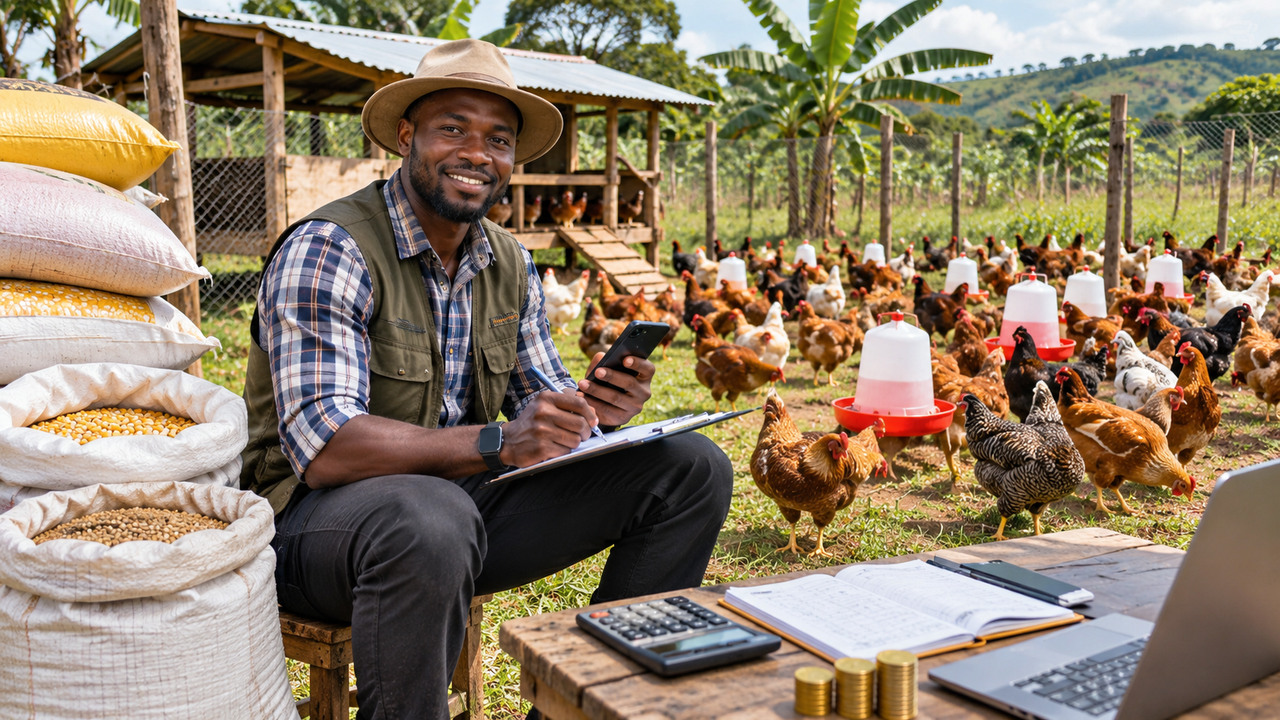
How Much Does It Cost to Raise 100 Free-Range Chickens?
Raising 100 chickens is a manageable way to test a poultry business before committing to a larger operation.
The biggest mistake is budgeting only for chicks and forgetting the feed, housing, medication, labour and money required until the birds are sold.
The following model uses the same 16-week improved-chicken assumptions as Article 52.
Detailed Cost Breakdown
| Expense | Cost for 100 birds |
|---|---|
| Day-old chicks | $200 |
| Supplementary feed | $252 |
| Veterinary and vaccination | $45 |
| Bedding and cleaning | $25 |
| Water and utilities | $20 |
| Marketing and transport | $45 |
| Labour | $100 |
| Miscellaneous allowance | $35 |
| Total cycle operating costs | $722 |
An additional $650 is allocated to basic reusable housing, fencing and equipment.
How Much Feed Will 100 Birds Need?
In this hypothetical model:
100 chicks × 6 kg = 600 kg of supplementary feed across the production cycle.
At $0.42/kg:
600 kg × $0.42 = $252.
Actual feed intake can be substantially different depending on genotype, age at sale, weather, forage availability and ration formulation.
Weigh a sample of birds regularly and compare growth against feed purchased.
Profit Under Different Selling Prices
Assuming 90 birds survive to sale:
| Selling price per bird | Revenue | Operating surplus |
|---|---|---|
| $8 | $720 | -$2 |
| $9 | $810 | $88 |
| $10 | $900 | $178 |
| $12 | $1,080 | $358 |
The table illustrates how heavily profitability depends on the achieved selling price.
A premium price should be supported by actual buyer demand, not assumed simply because birds are free-range.
What Happens When Mortality Increases? At the modeled selling price of $10:
| Saleable birds | Revenue | Operating surplus |
|---|---|---|
| 95 | $950 | $228 |
| 90 | $900 | $178 |
| 85 | $850 | $128 |
| 80 | $800 | $78 |
These scenarios hold expenses constant for comparison. In practice, mortality timing influences feed consumption and veterinary costs.
Steps to Control Production Expenses
Purchase quality chicks, minimise feed spillages, provide shade during hot weather and maintain secure nighttime housing.
In regions with heavy seasonal rain, such as parts of Uganda, Kenya and Tanzania, plan for muddy outdoor runs and wet bedding.
In hotter areas of Zimbabwe, Zambia and Southern Africa, provide accessible water and shaded areas.
FAQs
How long does it take to raise 100 indigenous chickens?
It depends on the chicken type. Selected improved birds may reach a particular market specification in roughly 12–20 weeks, while traditional indigenous birds may take considerably longer.
Can I profit from 100 free-range chickens?
Yes, potentially. The example generates a $178 operating surplus at a $10 sale price, but a lower sale price or increased expenses can eliminate it.
Should I buy chicks or mature growers? Chicks cost less per bird but require more time, brooding, feed and health management. Growers cost more upfront but can shorten the remaining production period.