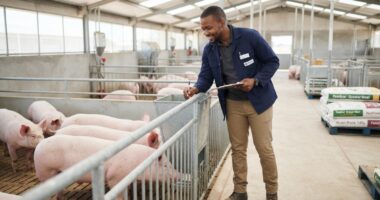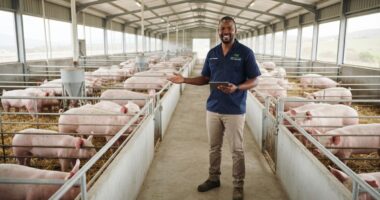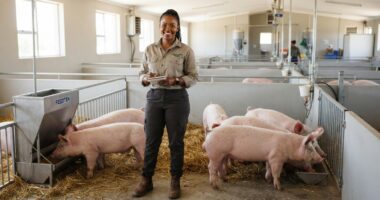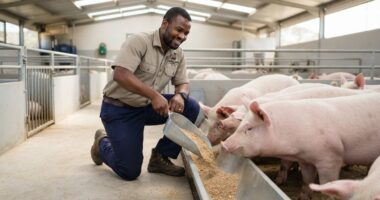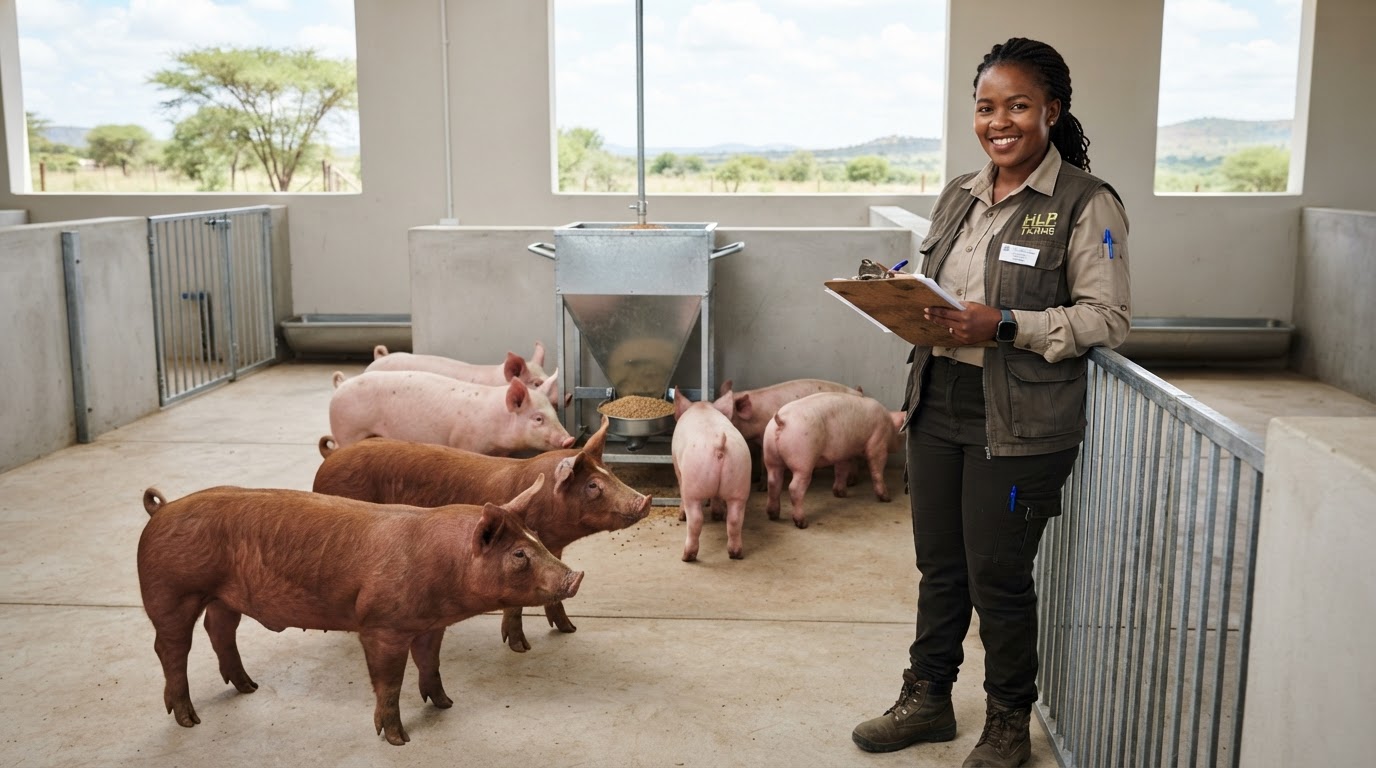
Is Raising Five Pigs a Good Business for Beginners? Raising five pigs can be a sensible entry point for farmers who want to understand pig production before committing substantial capital.
A five-pig project allows the farmer to test feed suppliers, housing arrangements, growth rates and local buyers.
The primary objective of the first cycle should be learning to produce healthy market-ready pigs at a measurable cost.
Step 1: Purchase Five Healthy Weaners
For this example, purchase five healthy weaners weighing approximately 20 kg each.
At an illustrative purchase price of $45 per pig:
5 × $45 = $225
Buy animals from a reputable source with appropriate health records.
Avoid mixing pigs from several unknown sources, as this can increase the risk of introducing disease into the piggery.
Step 2: Build a Small Pig Housing Unit
A simple five-pig facility should provide enough space for the pigs at their eventual market weight.
It should also allow easy feeding, cleaning, inspection and separation of animals if veterinary advice requires it.
Illustrative housing budget
Infrastructure Cost
Shelter and pen construction $500
Feeders and drinkers $100
Drainage, cleaning equipment and biosecurity
                                                     $100
provisions
Water storage and miscellaneous equipment            $50
Total                                                 $750
These costs are planning allowances. Local building materials, labour, site conditions and disease-control requirements will affect actual prices.
Poorly constructed housing may appear cheaper but become expensive through injuries, difficult cleaning and recurring repairs.
Step 3: Calculate Feed Requirements
In the FarmUP model, each pig gains 70 kg while consuming 224 kg of feed.
For five pigs:
5 × 224 = 1,120 kg of feed
At $0.32/kg:
1,120 × $0.32 = $358.40
Feed may be purchased in stages rather than all at once, but the farmer must have enough cash available throughout the cycle.
Step 4: Prepare the Full Operating Budget
Operating expense Cost
Five weaners $225
Feed: 1,120 kg $358.40
Veterinary care and health
                                    $40
allowance
Water and utilities $20
Labour allowance $50
Transport and marketing $40
Cleaning and miscellaneous $30
Total operating expenses            $763.40
The budget includes a modest labour allowance, but farmers should replace it
with a realistic figure for their own time and hired work.
Step 5: Estimate Revenue and Returns
Assume all five pigs reach 90 kg and sell at $2.20/kg liveweight.
Revenue per pig: $198.
Total revenue:
5 × $198 = $990
Operating surplus:
$990-$763.40 = $226.60
This represents a hypothetical operating surplus before infrastructure recovery and further business costs.
The first-cycle cumulative cash position is:
$990-$763.40-$750 = -$523.40
That does not necessarily mean the farm is economically unviable, because the housing is reusable. It does demonstrate the importance of planning for the initial investment.
Step 6: Understand the Risk of Losing One Pig
Small herds are particularly sensitive to mortality.
If only four pigs are sold at the same weight and price, revenue falls to $792.
Holding the modeled expenses constant:
$792-$763.40 = $28.60
A single lost pig would reduce the modeled operating surplus from $226.60 to $28.60.
If the surviving pigs also grow poorly or sell for less, the result may become negative.
Practical Tips for a Five-Pig Farm Maintain a consistent feeding schedule, monitor drinking water, keep pens dry, inspect animals daily and weigh or estimate liveweight regularly.
Do not bring visitors, borrowed equipment or newly purchased animals directly into the pig housing area without appropriate biosecurity precautions.
Begin approaching buyers several weeks before the pigs reach their intended selling weight.
FAQs
How much money is needed to start with five pigs?
The FarmUP example requires $1,513.40 in first-cycle cash, including $750 for reusable housing and equipment. Actual prices need local verification.
How much profit can five pigs generate?
The illustrative operating surplus is $226.60 if all five pigs reach 90 kg and sell at $2.20/kg. This is not guaranteed full profit.
Is five pigs enough for a business?
Five pigs can be a useful pilot. Whether that scale provides meaningful household income depends on margins, available capital and how frequently pigs can be sold.