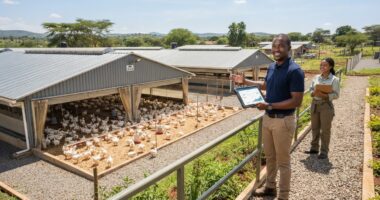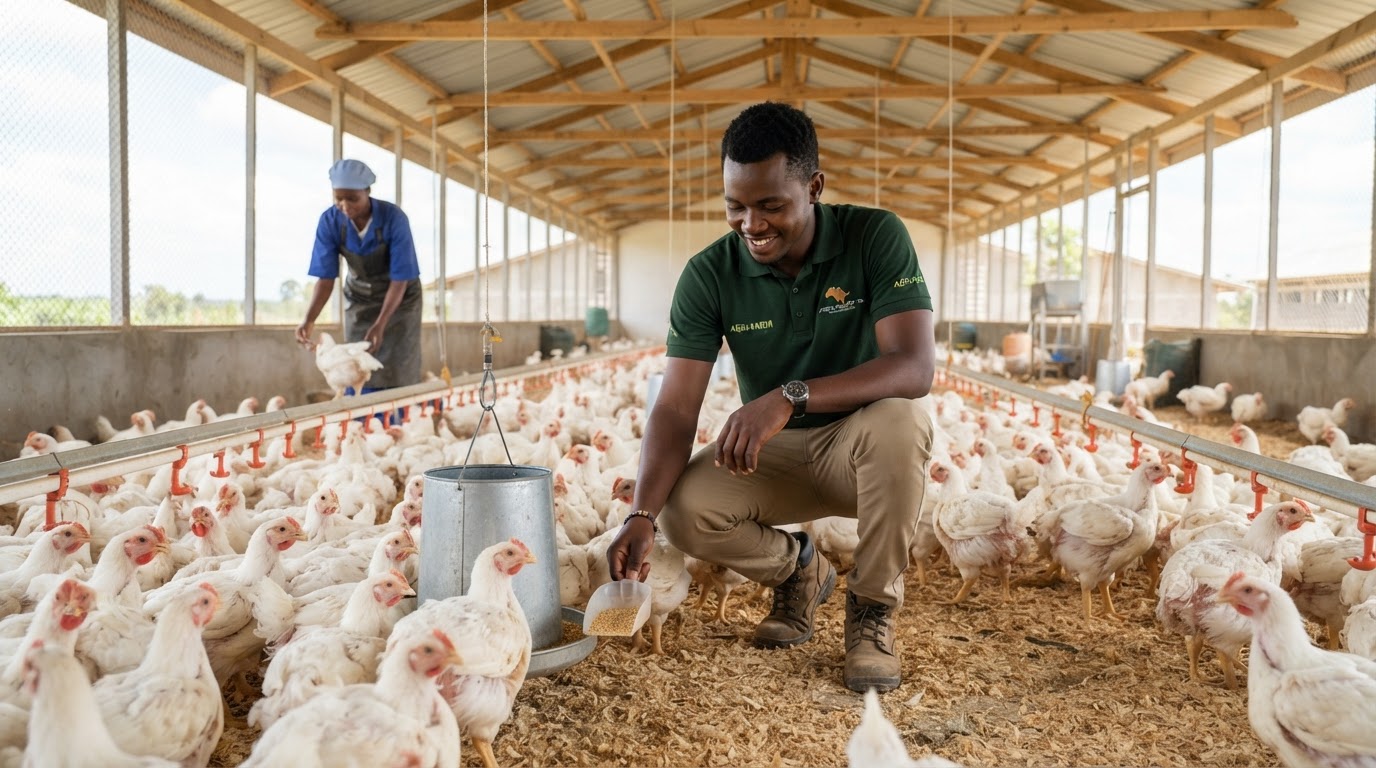
Broiler chicken farming involves raising specially selected meat chickens for sale to households, retailers, restaurants, butcheries and other customers.
Unlike indigenous chickens, commercial broilers are bred for rapid growth and efficient conversion of feed into meat. This can create relatively short production cycles, but profitability depends heavily on feed efficiency, mortality, selling price and dependable buyers.
Why Consider Broiler Farming?
Broiler production offers several potential advantages:
- Production can take roughly five to eight weeks, depending on the required sale weight.
- A small project may use an existing suitably converted building.
- Farmers can sell birds live or process them where legally permitted.
- Operations can expand gradually through additional batches. However, broilers require substantial feed expenditure, consistent supervision and effective disease prevention. FAO emphasizes that commercial meat birds need suitable housing, nutrition and management to perform well.
FAO+1
Who Is Broiler Farming Suitable For?
A 50–100-bird project may suit a beginner who has reliable water, a secure poultry house and someone available for daily care. Larger batches are more appropriate when the farmer has established buyers, working capital and reliable operational support.
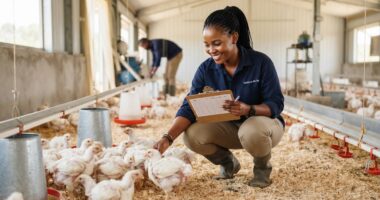
A broiler enterprise is not a hands-off side hustle. Birds require daily checks, especially during brooding and hot weather.
Climate Considerations Across Africa
Region Key production consideration
Southern
               Cold winter nights and hot summer afternoons
Africa
Altitude-related temperature differences and rainy-season
East Africa
               humidity
West Africa High heat, humidity and seasonal flooding in some locations
Central Africa Humidity, wet litter and ventilation
North Africa Hot, dry conditions and high cooling-water demand
Farmers should orient buildings to reduce direct sun exposure, ensure rainwater drains away, and maintain adequate airflow without exposing chicks to harmful drafts.
Step 1: Research Your Local Broiler Market
Before purchasing chicks, investigate customers and their buying requirements. Speak to butcheries, poultry traders, restaurants, caterers and household customers. Ask whether they prefer live chickens, dressed chickens, a particular weight, or regular delivery.
Record the selling price, desired volumes, payment arrangements and transport costs. A high retail price is not useful if you cannot access that market.
Step 2: Choose Your Starting Flock
Flock size Potential suitability
50 birds Learning brooding, feeding and recordkeeping
100 birds Small side-business pilot
500 birds Developing commercial enterprise
1,000 Higher-capital operation requiring established birds distribution
Avoid assuming that larger flocks automatically produce higher margins. Poor management can multiply losses.
Step 3: Construct or Prepare Housing
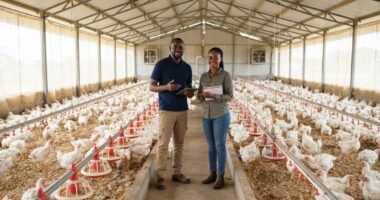
A basic broiler house needs a dry floor, washable equipment, weather protection, ventilation, drainage and protection from wild birds and predators.
For planning purposes, a hot-climate, naturally ventilated system might start with approximately 8–10 birds per square metre at the target sale weight, subject to welfare standards, housing design and local veterinary advice.
At 10 birds/m², 100 birds require around 10 m² of usable bird area; 500 require 50 m² and 1,000 require 100 m². These are preliminary space calculations, not universal stocking limits.
Step 4: Prepare Essential Equipment
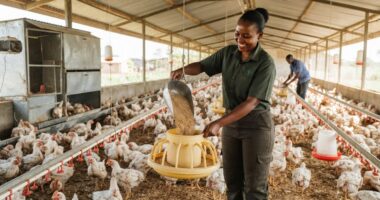
Obtain appropriate feeders and drinkers, a reliable brooding heat source, thermometer, weighing scale, litter, cleaning equipment and backup water supply. Do not place chicks before the house has been cleaned, disinfected, dried, bedded and brought to a suitable brooding environment.
Step 5: Purchase Quality Chicks and Feed
Choose a reputable hatchery that provides information about breed, chick health and vaccinations already administered.
Use a balanced commercial broiler ration appropriate to the birds’ age and genetic strain. Feeding programmes commonly move through starter, grower and finisher phases, although exact timing varies by product.
aa-intl.aviagen.com+1
Step 6: Manage the Production Cycle
Stage Priority
Before Cleaning, brooder setup, water and feed arrival preparation
Days 1–7 Brooding, chick activity and early growth
Feed intake, uniformity, litter and health
Days 8–21
              monitoring
Days 22–35 Ventilation, growth, feed efficiency and marketing
Sale readiness, customer collection and financial
Days 36–42+
              review
Actual slaughter or sale age depends on the market weight required.
Step 7: Prevent Disease
Control visitors and movement between farms, keep litter dry, exclude wild birds and rodents, and follow a locally approved veterinary health programme.
Avoid using antibiotics or vaccines without appropriate professional guidance.
Step 8: Calculate Business Profitability
For a 100-chick example:
                              Illustrative
Item
                              USD
100 chicks $110.00
Feed: 420 kg $176.40
Water and energy $35.00
Veterinary and health
                              $30.00
provision
Litter $30.00
Transport and marketing $45.00
Labour $55.00
Miscellaneous expenses $30.00
Operating cost $511.40
Housing and equipment,
                              $380.00
initial
First-cycle cash
                              $891.40
requirement
At 95 birds sold, averaging 2.1 kg at $2.90/kg, illustrative sales revenue is $578.55.
Operating surplus is $67.15, before depreciation, financing costs, taxes and owner profit allocation. First-cycle cash expenditure exceeds sales because the farmer also purchases reusable housing and equipment.
How to Grow the Business
Expand only after recording several batches and confirming that demand, cash flow and management can support growth.
Keep a production register showing chicks placed, daily deaths, feed purchases, average weights, veterinary expenses, sales and customer payments.
FAQs
Can I start broiler farming with 100 chickens?
Yes, provided housing, working capital, water, daily supervision and a realistic sales plan are available.
How long do broilers take to grow?
Some reach their intended market size in approximately five to eight weeks. The exact period depends on breed, environment, feeding and buyer specifications.
Can broiler farming be profitable?
It can be, but prices, mortality, feed conversion and costs determine whether a particular batch earns a surplus or suffers a loss.
Is broiler farming suitable for beginners?
Yes, at a manageable scale, ideally with training and access to local veterinary or agricultural-extension support.