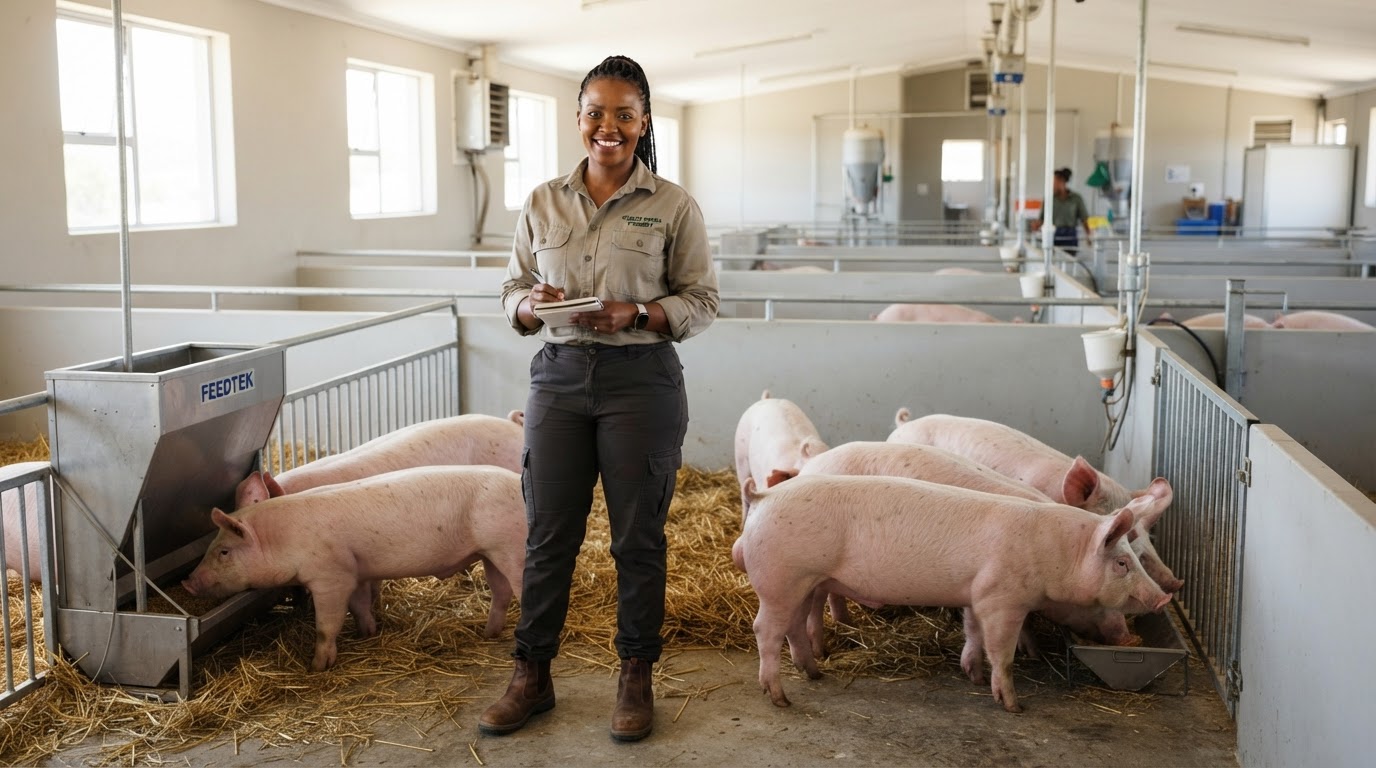
Why Start a Pig Fattening Business With Ten Pigs?
A ten-pig fattening business is a step beyond a small household pilot.
It allows farmers to purchase feed in larger quantities, develop regular buyers and measure production performance across a moderately sized group.
Unlike a breeding enterprise, a fattening project does not require permanent ownership of breeding sows or managing newborn piglets.
Nevertheless, it requires careful planning because the farmer must fund the entire growing period before receiving sales income.
Step 1: Select the Right Starting Pigs
Purchase ten healthy, reasonably uniform weaners from a reliable source.
Uniform pigs are easier to manage because their feed and housing needs tend to be similar.
The FarmUP example assumes ten pigs, each weighing 20 kg, purchased for $45.
Total pig purchase cost: $450.
Keep documentation showing their source and any relevant health information.
Step 2: Establish a Secure Fattening Facility
The piggery should provide adequate space, durable floors, drainage, ventilation and a dependable clean-water supply.
Provide shelter from direct sunlight, especially during hot periods in Southern Africa. Avoid overcrowding. Larger pigs need more floor area than newly purchased weaners.
A suitable ten-pig unit may require multiple pens depending on animal size, behaviour and the layout of the building.
For financial planning, this example allocates $1,250 to reusable housing, feeders, drinkers, water provisions and basic biosecurity infrastructure.
Step 3: Calculate Your Feed Supply
Each pig is budgeted for 224 kg of feed from 20 kg to 90 kg.
For ten pigs:
10 × 224 = 2,240 kg
At $0.32/kg, total feed cost is $716.80.
In reality, feed use should be checked throughout the fattening cycle.
A typical feeding programme progresses from appropriate grower feed toward finisher feed as pigs mature.
Poor feed conversion, illness and feed wastage can quickly change the business result.
Step 4: Prepare Your 10-Pig Budget
Operating expense Cost
Ten weaners $450
Feed $716.80
Veterinary care and health
                                     $80
allowance
Water and utilities $40
Labour allowance $100
Transport and marketing              $80
Cleaning and miscellaneous          $60
Total operating costs $1,526.80
Add the $1,250 reusable infrastructure allowance.
Total illustrative first-cycle cash requirement: $2,776.80.
Step 5: Calculate Sales and Operating Surplus
Assuming all ten pigs are sold at 90 kg:
Total liveweight sold:
10 × 90 = 900 kg
Revenue at $2.20/kg:
900 × $2.20 = $1,980
Operating surplus:
$1,980-$1,526.80 = $453.20
The first-cycle cumulative cash position, including the entire initial infrastructure expense, would be −$796.80.
Later cycles may use the same housing, subject to maintenance, repairs and depreciation.
Step 6: Test Price and Mortality Sensitivity
Sales       Operating
Scenario
                         revenue     surplus
10 pigs sold at
                         $1,620      $93.20
$1.80/kg
10 pigs sold at
                         $1,980      $453.20
$2.20/kg
10 pigs sold at
                         $2,250      $723.20
$2.50/kg
9 pigs sold at
                       $1,782         $255.20
$2.20/kg
These scenarios keep the original operating budget constant. Actual expenses may differ if a pig dies early, grows slowly or requires additional veterinary attention.
Step 7: Organize Production and Sales
Create a batch record showing arrival date, pig identification, starting weight, feed purchases, estimated weekly weight and health observations.
Ask your buyer whether the preferred delivery specification is 80 kg, 90 kg, 100 kg or another weight range.
The ideal selling weight is not necessarily the heaviest possible pig. It is the weight that provides the most attractive net return after additional feeding and marketing costs.
FAQs
Can ten pigs generate regular income?
A ten-pig business may generate income from repeated batches, but money usually arrives when pigs are sold. Plan carefully for the months between sales.
Do I need breeding sows to fatten pigs?
No. A farmer can purchase healthy weaners and raise them to market weight.
What is the main expense in a ten-pig business?
In this model, feed is the largest single operating expense.