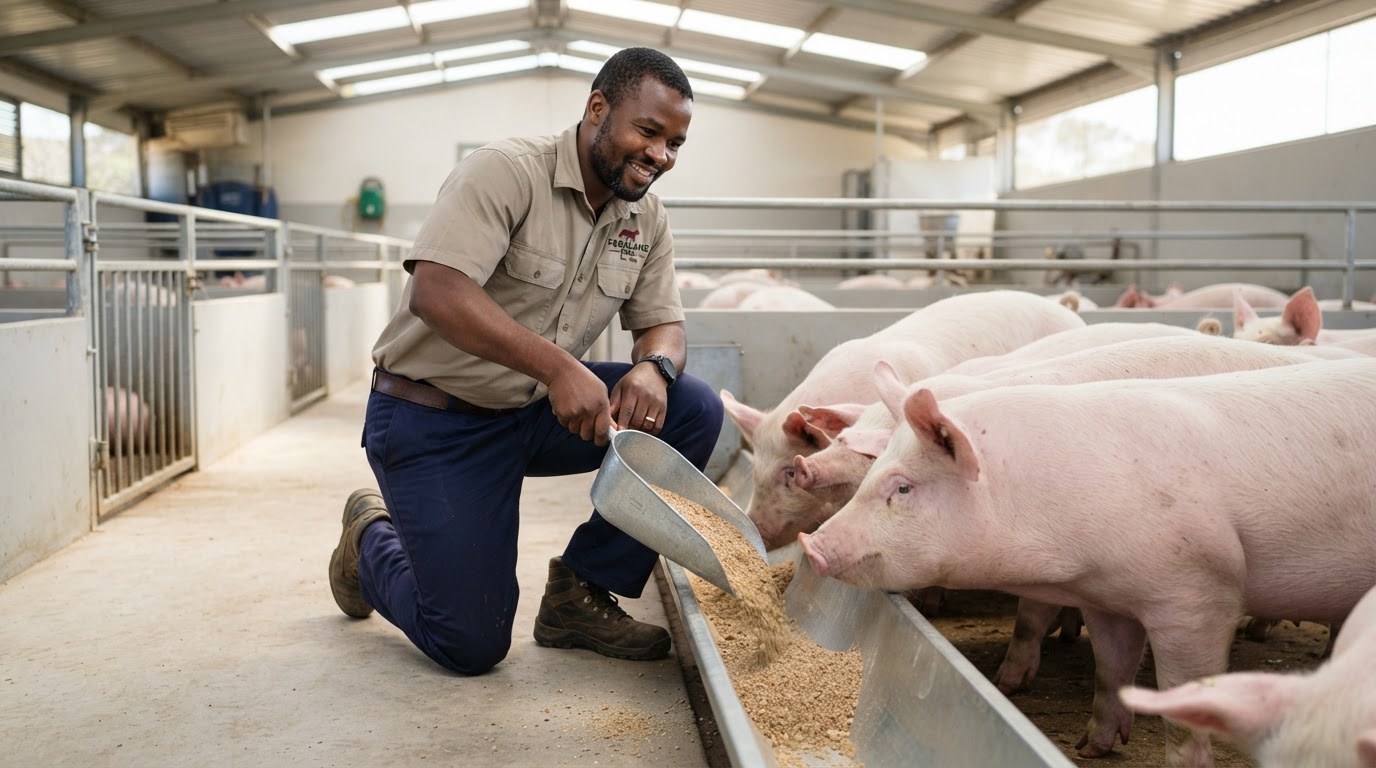
What Should Pigs Eat for Healthy Growth? Feeding is one of the most important parts of pig farming because pigs must receive the nutrients required to maintain health, grow efficiently and reproduce.
A cheap feed mixture is not automatically economical.
If pigs take longer to reach market weight because of poor nutrition, the farm may spend more on feed, labour, water and housing than it saves on ingredients.
Commercial pig feeding programmes should therefore be designed around the animal’s age, liveweight and production stage.
Feeding Pigs at Different Growth Stages
Production
                 Nutritional priority           Feeding approach
stage
Suckling         Milk intake and early digestive Sow's milk and suitable creep feed
piglets          development                    where advised
Newly weaned
                 Highly digestible nutrients    Appropriate weaner ration
pigs
Protein, energy and skeletal
Grower pigs                                     Balanced grower feed
                 growth
Finisher pigs Efficient liveweight gain Suitable finisher ration
Maintenance and fetal
Pregnant sows                                   Controlled gestation diet
                 development
Milk production and body
Lactating sows                                  Nutrient-dense lactation diet
                 condition
Healthy body condition and
Breeding boars                                  Appropriate breeder ration
                 fertility
The precise nutritional specifications differ by breed, weight, feed ingredients and production environment.
The AHDB’s feeding guidance discusses nutrient requirements and feeding strategies across different growing and finishing weights. AHDB
How Much Feed Does a Fattening Pig Need?
Feed conversion ratio measures the quantity of feed used to produce one kilogram of liveweight gain.
FCR = (Feed consumed ÷ Liveweight gained)
For example, a pig gaining 70 kg while consuming 224 kg of feed has:
FCR = 224 ÷ 70 = 3.2
A lower FCR generally indicates less feed consumed per kilogram of weight gained, but comparisons need to account for feed type, genetics, age and starting weight.
The FarmUP model uses this hypothetical result for budgeting, rather than treating it as a guaranteed standard.
Local Pig Feed Ingredients in Africa
Depending on local availability, commercial pig diets may contain combinations of:
Maize or other suitable cereal grains.
Soybean meal and other protein sources.
Wheat bran or suitable milling by-products.
Professionally formulated vitamin and mineral premixes.
Other legally permitted, quality-controlled ingredients.
Farmers in Zimbabwe, Zambia, Kenya and Tanzania may investigate locally available maize and oilseed products.
In West Africa, feed formulators may consider regionally available crops and agro-industrial by-products.
However, ingredients are not nutritionally interchangeable. A qualified livestock nutritionist should formulate diets that meet energy, amino acid, mineral and vitamin requirements. Can Farmers Reduce Costs by Mixing Their Own Feed?
Home mixing can be economical when the farmer has reliable ingredients, accurate weighing equipment and competent formulation advice.
It can be uneconomical or harmful when ingredients are unbalanced, contaminated or inconsistent.
Mouldy grain can contain mycotoxins. Poor-quality protein sources can reduce growth performance. Incorrect mineral supplementation may also cause serious problems.
Buying a nutritionally appropriate complete ration may be a better choice for a beginner than attempting to create a diet based only on the cheapest available ingredients.
Why Water Is Essential
Pigs need continuous access to clean drinking water.
Water intake rises with feed consumption, body size, hot weather and, particularly, lactation.
A broken drinker may reduce feed intake and growth even when feed is available.
Check drinkers daily, monitor flow and provide reserve storage where water supplies are unreliable.
Seasonal Feeding Considerations
During the hot season, pigs may eat less because of heat stress.
Farmers should improve shade, airflow, cooling where suitable and water availability rather than simply increasing feed allowances.
During rainy seasons, feed storage must protect ingredients from moisture, rodents and contamination.
Forage or local by-products should never compromise nutritional balance or disease-control requirements.
Important warning about food waste Feeding untreated kitchen waste or pork-containing scraps can introduce serious animal diseases. Swill-feeding rules differ by country, and some types of waste feeding are prohibited. Check local law and veterinary guidance rather than assuming leftovers are safe.
How to Calculate Feed Cost per Kilogram of Gain
Using the FarmUP example:
Feed price: $0.32/kg.
FCR: 3.2.
$0.32 × 3.2 = $1.024
The modeled feed cost is approximately $1.02 per kilogram of liveweight gain.
This is the feed component only. It excludes pig purchases, labour, veterinary care and other expenses.
FAQs
Can pigs grow on maize alone?
Maize can contribute dietary energy, but it does not supply a complete balanced ration for growing or breeding pigs.
How many times a day should pigs be fed?
The appropriate schedule depends on age, feeding system and diet. Follow the feed manufacturer’s or nutritionist’s recommended programme.
How can I reduce pig feed costs?
Reduce waste, compare suppliers, use balanced rations and monitor growth and feed conversion.