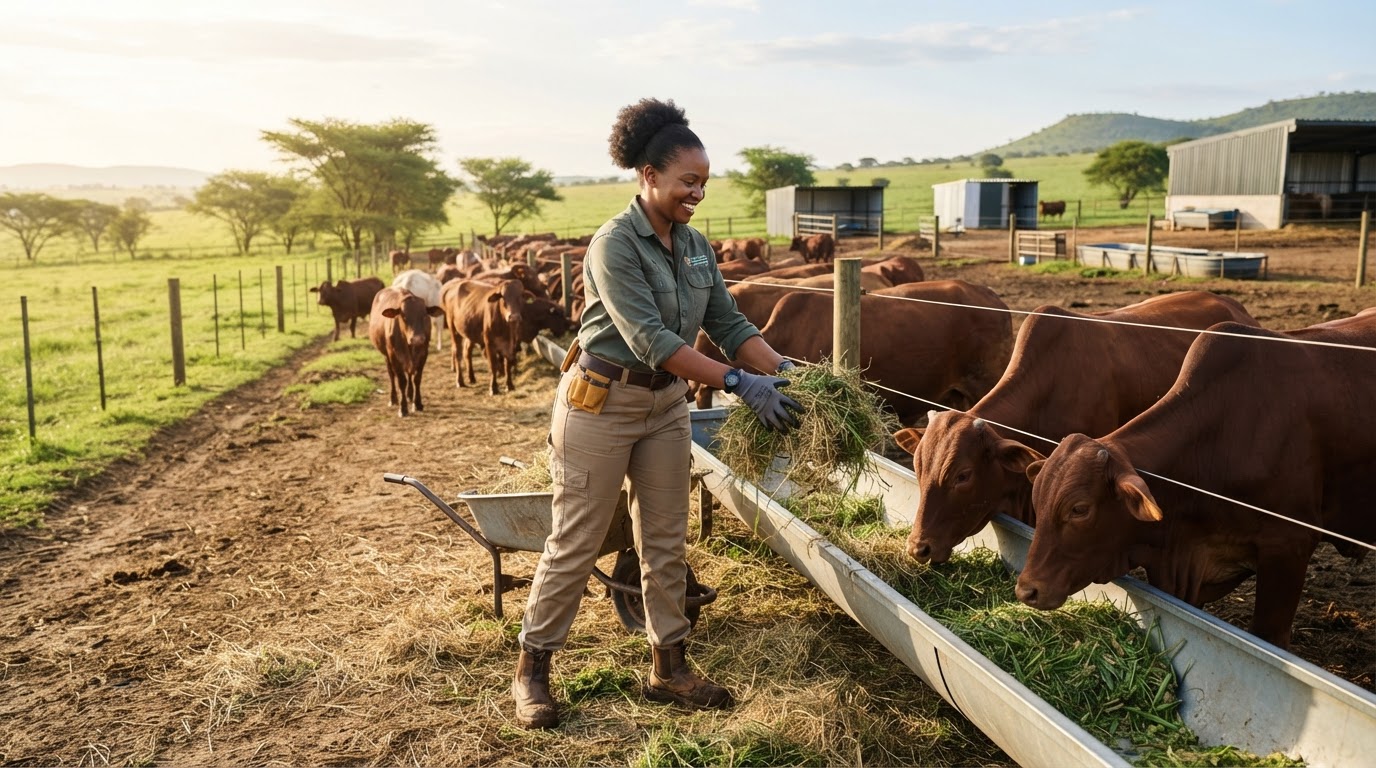
Category: Cattle & Dairy Farming | Livestock Nutrition
Introduction
Feed is one of the most important factors influencing cattle growth, reproduction, milk yield and profitability.
Across Africa, seasonal rainfall creates significant differences in forage availability. A farm may have abundant grazing during the wet season but insufficient feed during prolonged dry periods.
Successful farmers prepare for these seasonal changes before livestock begin losing weight or producing less milk.
1. Understand Cattle Nutritional Needs
Cattle need adequate quantities of energy, protein, fibre, minerals, vitamins and water.
Nutrient requirements depend on animal weight, age, pregnancy, growth, milk production and climate.
Beef cows maintaining body condition on pasture have different requirements from fast-growing cattle being fattened or high-producing dairy cows.
2. Common Feed Resources
Feed resource           Common use                    Main consideration

Grazing-based cattle
Natural pasture                                       Seasonal quality changes
                        production
                          Grazing or cut-and-carry     Land, water and
Planted forage grasses
                          feeding                      management

Storage and nutritional
Hay                       Dry-season feed reserve
                                                       quality

Correct preparation and
Silage                    Conserved succulent forage
                                                       storage

Often low protein and
Crop residues             Supplementary roughage
                                                       digestibility

Crop suitability and ration
Legume forage             Protein supplementation
                                                       balance

Commercial                Support growth or milk
                                                       Cost and correct feeding
concentrates              production

Mineral supplements Address nutritional needs          Local mineral deficiencies
The FAO identifies pastures, crop residues, forage crops and local feedstuffs as important resources for small-scale dairy production.
3. How Much Feed Does a Cow Need?
A preliminary planning estimate for total dry-matter intake is often around 2–3% of body weight daily for many cattle, with important variation by production level and feed quality.
For illustration, consider a 400 kg cow consuming dry matter equal to 2.5% of its body weight.
400 × 0.025 = 10 kg dry matter/day
For five similar cows:
5 × 10 = 50 kg dry matter/day
Over 90 days:
50 × 90 = 4,500 kg dry matter This calculation does not mean that five cows need only 4,500 kg of fresh grass. Fresh forage contains substantial moisture, and feed losses must also be considered.
Seek professional advice when preparing complete dairy or feedlot rations.
4. Establish Fodder Crops
Depending on local conditions, farmers may investigate:
- Napier or elephant grass.
- Rhodes grass.
- Brachiaria or Urochloa forage varieties.
- Forage sorghum.
- Maize for silage.
- Suitable forage legumes.
- Other locally recommended pasture species.
Choose crops based on rainfall, temperature, soils, water availability and intended livestock use.
Fodder should not displace food crops without a clear assessment of total farm profitability.
5. Plan for Seasonal Rainfall
Southern Africa
In many parts of Zimbabwe, Zambia, Botswana and neighbouring countries, summer rainfall supports seasonal pasture growth, followed by a dry period when grazing quantity and quality decline.
A farmer may need hay, crop residues or other conserved feed through the dry months.
East Africa
In Kenya, Tanzania and Uganda, seasonal rainfall patterns vary considerably by location.
Some areas experience distinct long and short rainy seasons; others have different or less predictable rainfall patterns.
Feed plans should use local rainfall experience rather than assuming one calendar fits an entire country.
6. Rotational Grazing
Rotational grazing involves moving cattle between grazing areas to manage forage utilization and allow recovery.
A practical plan should account for available pasture biomass, plant recovery, stocking pressure, water access and season.
Rotational grazing does not automatically make overstocked land sustainable. Total livestock demand must remain compatible with forage production.
7. Prevent Dry-Season Feed Shortages
Before the dry season:
1. Estimate the expected number and size of cattle.
2. Calculate likely dry-matter requirements.
3. Measure or estimate existing stored forage.
4. Account for storage and feeding losses.
5. Identify supplementary feed suppliers.
6. Reserve funds for emergencies.
7. Reduce herd numbers if feed supplies cannot support the animals.
8. Feed Storage and Safety
Store hay in dry, protected conditions.
Silage must be prepared and stored correctly to reduce spoilage and contamination. Discard visibly mouldy or otherwise unsafe feed.
Avoid sudden changes to high-concentrate rations, which can trigger digestive disorders.
9. Managing Water Requirements
Water intake varies with body weight, diet, weather, pregnancy and milk production.
Lactating cows and cattle in hot conditions can need particularly large quantities.
Build water systems around expected peak demand, not minimum cool-weather consumption.
Frequently Asked Questions
Can cattle survive on natural pasture alone?
Sometimes, depending on forage quality and production stage. Many farming systems require seasonal supplementation.
Is growing fodder cheaper than buying feed?
It can be, but land, irrigation, harvesting, storage and labour costs should be included.
How do I calculate cattle carrying capacity?
Estimate usable forage production and compare it with herd demand over the relevant grazing period, allowing for plant recovery and environmental protection.