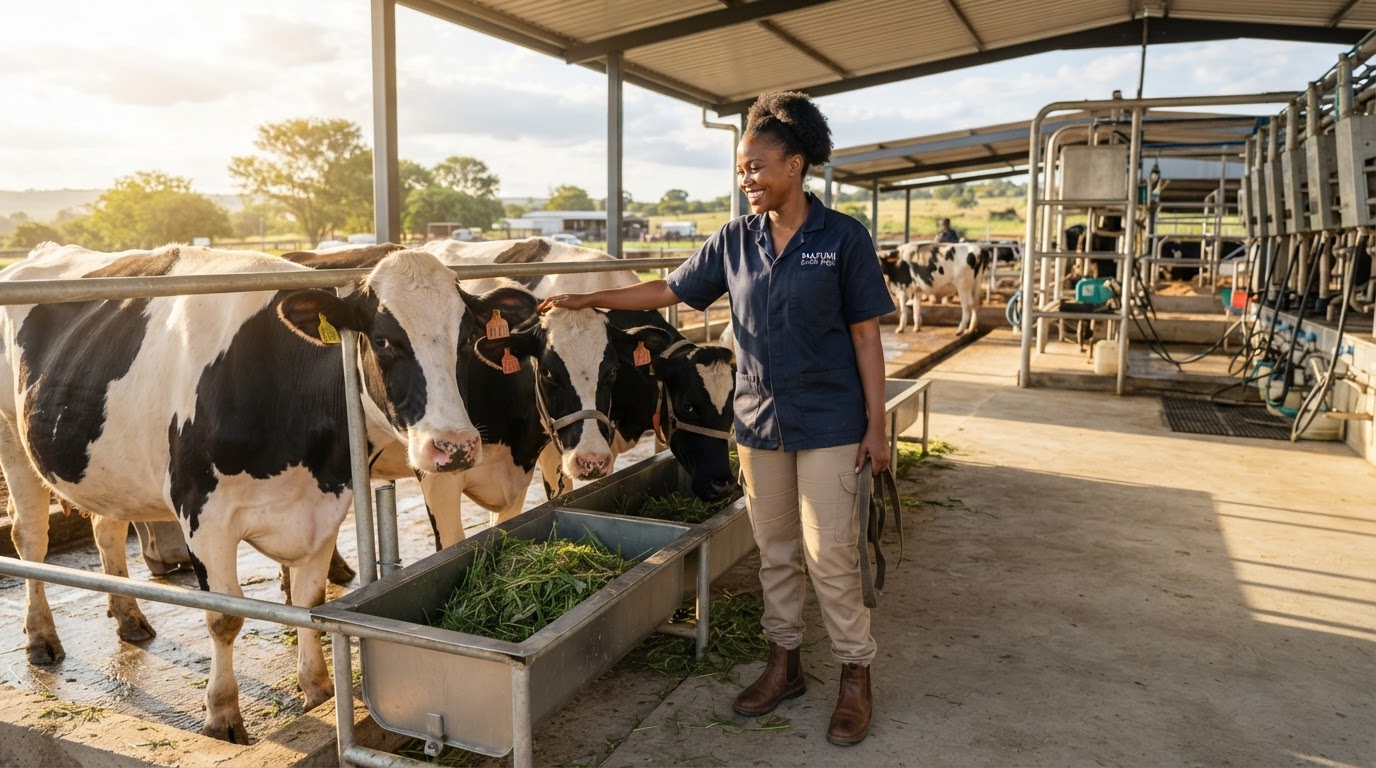
Category: Cattle & Dairy Farming | Dairy Startup Guide
Introduction
Dairy farming provides the opportunity to generate frequent income from milk
sales rather than depending solely on occasional livestock sales.
A small dairy operation may sell milk to registered processors, cooperatives or other lawful buyers.
However, milk production requires consistent feed, clean water, hygienic milking practices, daily labour and dependable collection arrangements.
A dairy farmer must manage production and food safety every day.
1. Research the Milk Market
Before buying dairy cows, find out:
- Who purchases milk locally.
- Whether direct raw milk sales are permitted.
- What quality tests or standards buyers require.
- Whether milk cooling facilities are available.
- What transport or collection charges apply.
- How and when farmers are paid.
Milk that cannot be sold safely and quickly may have little commercial value.
2. Choose Your Dairy Farming System
Dairy
               Description                               Main consideration
system
Grazing-       Cows obtain much of their forage
                                                    Seasonal pasture availability
based          from pasture

Semi-          Grazing plus cut forage and
                                                    Feed management
intensive      supplements

High daily feed and labour
Zero-grazing Feed delivered to housed cattle
                                                    demands
Farmers with limited grazing land may consider a cut-and-carry system, but the availability and cost of fodder remain essential.
3. Choose Dairy Cows
Holstein-Friesian, Jersey, Ayrshire and suitable dairy crossbreeds are among the options.
Do not select cows based on breed alone.
Review milk records, age, calving history, udder health, reproductive performance and local adaptation.
A high-yielding animal may also require higher feed expenditure.
4. Prepare Suitable Housing
A dairy facility should have:
- Dry resting areas.
- Shade and ventilation.
- Safe, non-slip walking surfaces.
- Reliable water access.
- Cleanable feed troughs.
- Secure manure management.
- A clean milking area.
- Safe access for veterinary examinations.
The design must match animal size, the housing system and the climate. 5. Understand Feeding Requirements
Milk production requires substantial energy, protein, water and minerals.
Dairy rations should balance forage quality, milk yield, lactation stage and animal
health.
FAO guidance emphasizes using suitable local feed resources while managing the nutritional demands of milk-producing livestock.
6. Practice Hygienic Milking
Before milking:
1. Wash hands and prepare clean equipment.
2. Inspect the cow and udder.
3. Clean and dry teats using an appropriate hygiene procedure.
4. Milk in a clean environment.
5. Check for abnormal milk or signs of mastitis.
6. Filter and cool milk according to applicable safety and buyer requirements.
7. Clean and sanitize equipment after use.
Milk from cows under medication may be subject to withdrawal periods and must not be sold until the applicable requirements are met.
Good milking hygiene and equipment cleaning are core parts of FAO small-scale dairy guidance.
7. Illustrative Three-Cow Dairy Startup Budget
Estimated
Expense
                                   cost

Three dairy cows                   $3,600
Housing improvements                 $900

Water and feeding equipment          $350

Milking equipment                    $250

Feed reserve                         $700

Veterinary and breeding
                                     $250
provision

Cooling and milk handling
                                     $400
allowance

Transport and contingency            $450

Total                                $6,900
Land purchase, permanent staff and substantial cooling infrastructure are excluded.
8. Example Milk Revenue
Suppose two cows are currently lactating and produce 10 saleable litres each per day.
At an assumed farm-gate price of $0.45 per litre:
2 × 10 × 30 × $0.45 = $270
The example generates $270 gross monthly milk revenue.
This figure excludes feed, veterinary care, labour, electricity, transport and other expenses.
The third cow may be pregnant, dry or at another production stage. A farmer should not assume all cows will produce milk throughout the year.
Frequently Asked Questions
Can I start dairy farming with two cows?
Yes. A two-cow project can provide experience, although milk output and cash flow may vary considerably. Is dairy farming more profitable than beef farming?
Not necessarily. Dairy can provide frequent sales, but it also requires frequent expenditure and daily management.
What is the biggest challenge?
Feed availability, milk quality, animal health and reliable sales are among the major challenges.