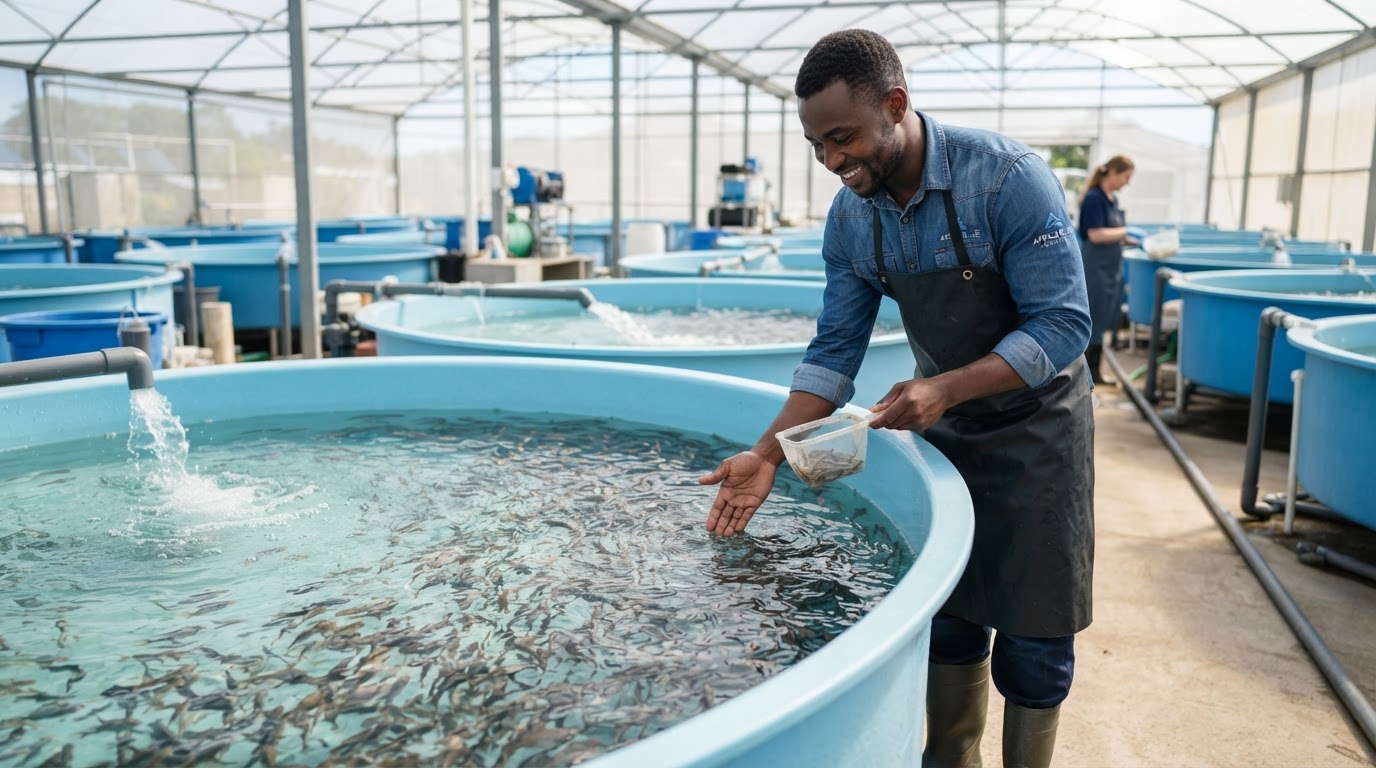
Category: Alternative Livestock & Aquaculture | Startup Costs & Profit Analysis
Introduction
A 1,000-fingerling fish farming project is a useful scale for learning commercial aquaculture budgeting. However, stocking 1,000 fish does not guarantee that 1,000 fish will be harvested. The actual outcome depends on pond capacity, survival, feed efficiency, water quality and harvesting weight. Before purchasing fingerlings, calculate the total capital and operating costs for the entire production cycle.
1. Determine the Required Production Space
Stocking density depends on fish species, production intensity, water exchange, aeration and feed management. As an example, a relatively low-intensity tilapia pond operating at two fingerlings per square metre would require 1,000 ÷ 2 = 500 m². This is an illustrative layout calculation, not a recommended density for every site. Kenyan fisheries guidance describes a two-fish-per-square-metre stocking approach for particular tilapia pond systems.
2. Estimate Fingerling Costs
Suppose a hatchery quotes $0.20 per healthy fingerling. 1,000 × $0.20 = $200. Transport, handling and mortality risks must also be considered. Cheap fingerlings are not necessarily economical if their quality is poor.
3. Sample 1,000-Fingerling Budget
Illustrative USD budget assuming the pond already exists.
| Expense | Amount |
|---|---|
| 1,000 fingerlings | $200 |
| Commercial feed | $950 |
| Water management and testing | $160 |
| Harvesting equipment | $120 |
| Electricity and pumping | $180 |
| Health and biosecurity provision | $100 |
| Transport and selling costs | $160 |
| Contingency | $230 |
| Total operating and equipment budget | $2,100 |
For a newly constructed pond, include separate excavation, embankment, water-supply and drainage costs.
4. Calculate Survival and Harvest Weight
Suppose 85% of stocked fish survive. 1,000 × 0.85 = 850 fish. At 0.6 kg average harvest weight, 850 × 0.6 = 510 kg. The farm would harvest an estimated 510 kg of fish.
5. Revenue and Profit Example
At an assumed $4 per kg, 510 × $4 = $2,040. Against total project costs of $2,100, $2,040 − $2,100 = −$60. This example produces a $60 first-cycle deficit. Reducing unnecessary feed costs, improving survival, securing higher prices or using existing equipment across multiple cycles may improve results.
6. Calculate Your Own Fish Farming Profit
For an individual project, calculate fish harvested as the number of fingerlings multiplied by the expected survival percentage. Multiply harvested fish by average market weight to obtain kilograms. Multiply kilograms by selling price to find sales revenue, then subtract the full cycle costs to estimate the surplus or loss. Illustrative baseline: 1,000 fingerlings; 85% survival; 0.6 kg average weight; $4/kg sale price; $2,100 total cycle costs. The resulting 850 fish yield 510 kg, $2,040 revenue and a $60 deficit. The original interactive calculator is not reproduced as a nonfunctional WordPress element.
7. Prepare a Cash-Flow Budget
Fingerlings and feed usually require payment before the farmer receives harvest revenue. Calculate the amount needed to complete a full cycle, plus reserves for water-system repairs, slow growth and delayed sales. Do not use all available funds to purchase fingerlings while leaving insufficient money for feeding.
8. Common Budgeting Mistakes
Overestimating fish survival, ignoring water and electricity expenses, assuming retail prices for wholesale sales, and failing to budget for harvest transport can lead to losses. Maintain a record of each expense and compare actual feed use with fish growth.
Frequently Asked Questions
How much does it cost to raise 1,000 tilapia?
The illustrative model requires $2,100 with an existing pond, but actual costs depend heavily on location and production system.
How much fish can 1,000 fingerlings produce?
In the example, 850 survivors averaging 0.6 kg generate 510 kg of fish.
Does every fish farming cycle make a profit?
No. Poor survival, feed costs or low selling prices can produce a loss.