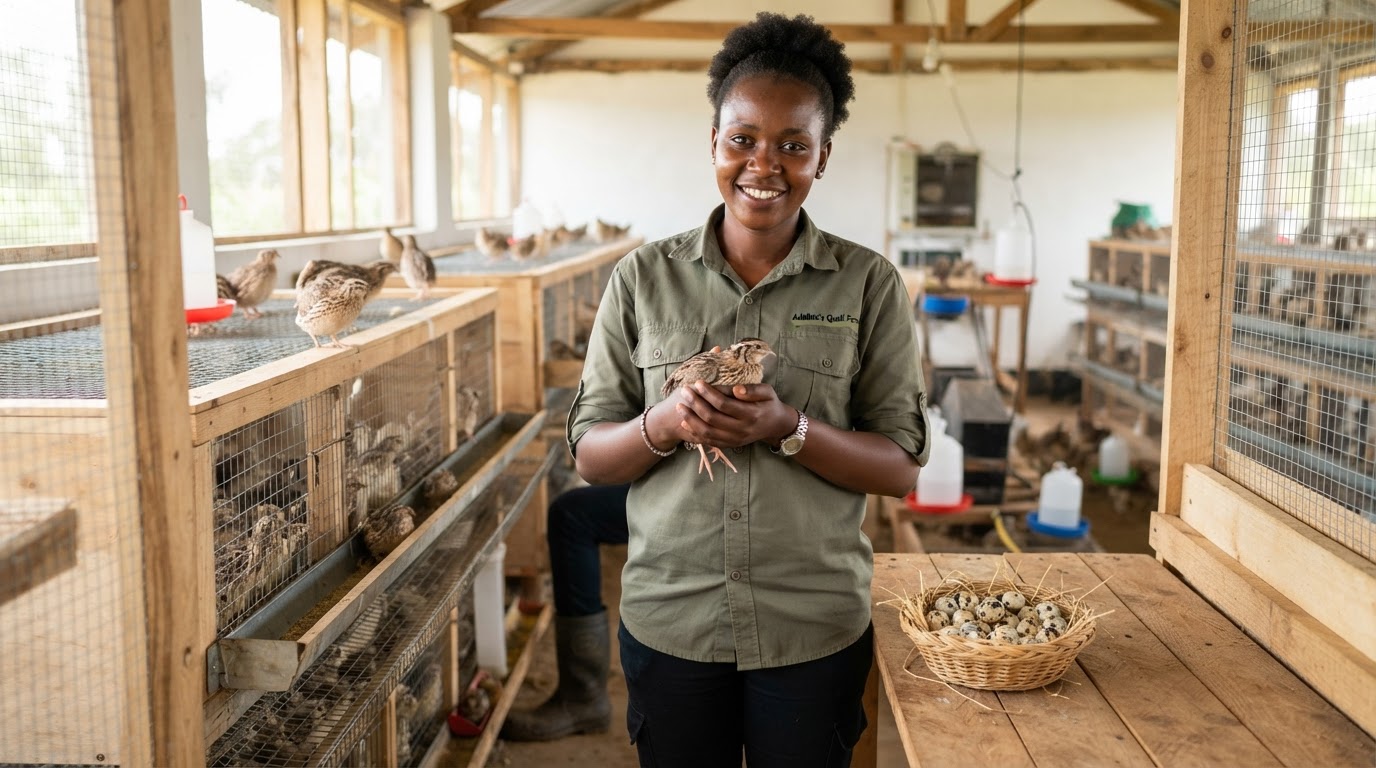
Category: Alternative Livestock & Aquaculture | Quail Meat & Egg Production
Introduction
Quail farming is an alternative poultry enterprise that may suit farmers with limited space and access to specialist egg or meat markets. Domestic quail, particularly Japanese quail (Coturnix japonica), are raised for eggs, meat and breeding stock. Quail can mature relatively quickly, but this does not make them a guaranteed high-profit enterprise. Demand for quail products is often smaller than demand for conventional chicken meat and eggs.
1. Research Local Demand
Before buying birds, identify potential customers. These may include specialty restaurants, health-food retailers, hospitality businesses, farmers’ markets and private households. Ask whether buyers prefer fresh eggs, packaged eggs, dressed quail or live breeding birds. Check applicable food-safety, slaughter and egg-marketing regulations.
2. Choose Your Quail Farming Model
| Business model | Main product | Key consideration |
|---|---|---|
| Quail egg production | Table eggs | Consistent egg buyers |
| Quail meat production | Finished birds | Market size and processing |
| Breeding and hatching | Chicks or breeding birds | Incubation and genetics |
| Mixed production | Eggs and meat | More complex management |
Beginners should choose a primary product before planning flock size.
3. Design Quail Housing
Quail need secure, ventilated housing protected from predators, extreme temperatures and rain. Provide appropriate space, clean water, feed access and safe flooring. Avoid overcrowding, sharp edges and stressful handling. A covered aviary or appropriately designed cage system may be used depending on animal welfare requirements and the production model.
4. Example Startup Budget for 100 Quail
Illustrative USD startup budget for an egg-focused flock.
| Expense | Cost |
|---|---|
| 100 suitable young birds | $150 |
| Housing and cages | $250 |
| Feeders and drinkers | $60 |
| Initial feed reserve | $110 |
| Lighting and equipment | $50 |
| Biosecurity and health provision | $40 |
| Egg packaging | $35 |
| Transport and contingency | $105 |
| Total | $800 |
Actual costs depend on local bird prices, housing conditions and whether existing facilities are available.
5. Quail Feeding and Care
Use feed formulated for the age and production stage of quail or an appropriately formulated alternative recommended by a poultry nutrition specialist. Egg-laying birds have different nutritional requirements from growing meat birds. Provide clean water at all times.
6. Estimate Egg Production
Suppose 80 of the 100 birds are laying females and average 20 marketable eggs per bird each month. 80 × 20 = 1,600 eggs. If eggs are sold in packs of 12: 1,600 ÷ 12 ≈ 133 packs. Assuming $1.50 per pack, with only complete packs sold: 133 × $1.50 = $199.50. This is illustrative gross monthly revenue. Feed, labour, replacement birds, packaging and distribution must be deducted. Actual laying performance depends on age, nutrition, management and other factors.
7. Prevent Poultry Diseases
Quail may be affected by infectious diseases, parasites, injury and poor housing conditions. Maintain good sanitation, control visitors and pests, and obtain veterinary advice for disease investigation. WOAH guidance emphasizes biosecurity as a central component of commercial poultry production.
8. Market Quail Products Carefully
A business should not rely on unsupported medical claims about quail eggs. Promote product freshness, traceability, preparation ideas and consistent supply instead.
Frequently Asked Questions
Is quail farming profitable in Africa?
It can be profitable where a dependable market exists and expenses are controlled.
How much space does quail farming require?
The amount depends on flock size, housing type and local welfare requirements.
Can I start with 50 quail?
Yes, a smaller flock may be appropriate for learning production and testing buyer demand.