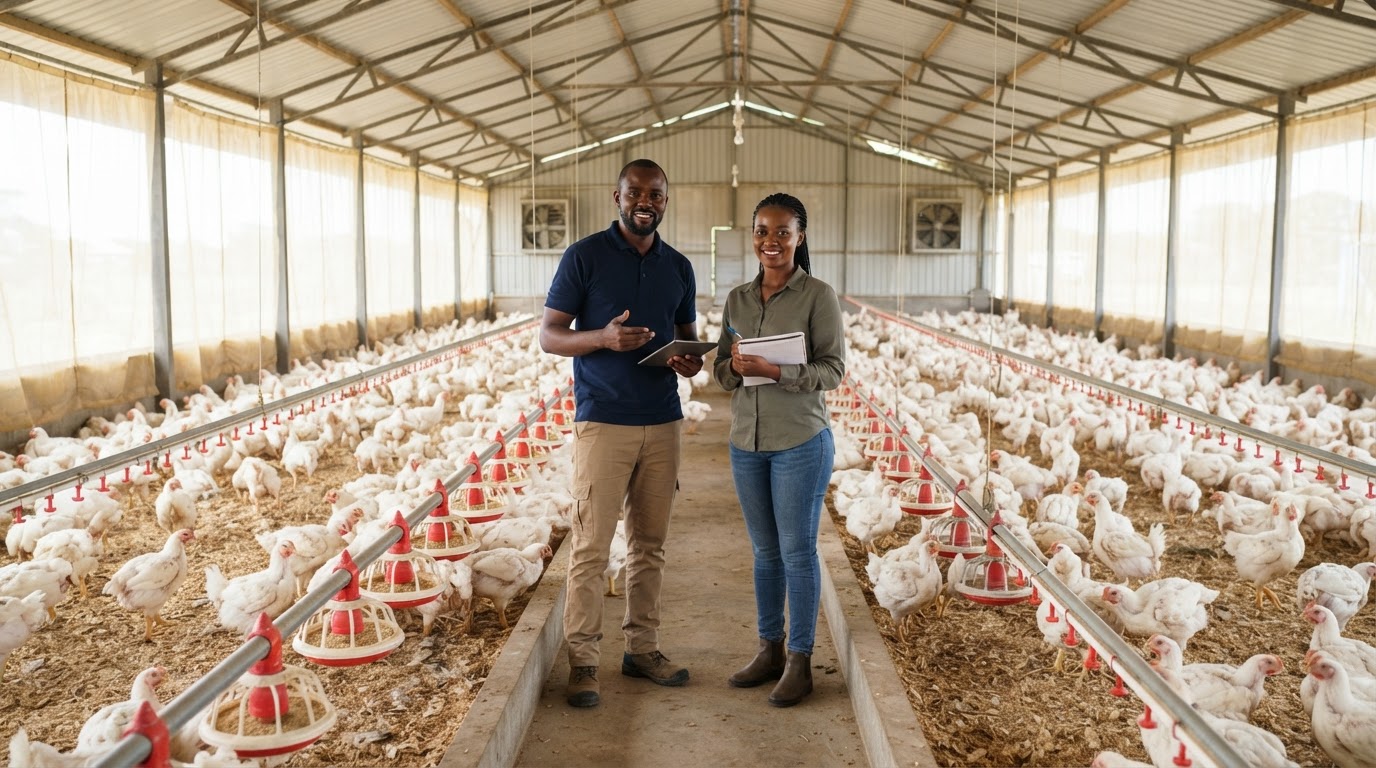
A 1,000-broiler project is a commercial poultry venture that requires stronger financial controls, reliable farm infrastructure, disease-management systems and an established route to market.
Producing 1,000 chickens is not simply the same as raising 100 chickens ten times. The financial exposure, labour requirements, logistics and consequences of disease outbreaks are substantially greater. Who Should Consider a 1,000-Broiler Project?
This scale is more suitable for farmers who have previously managed successful broiler batches and understand how to control feed wastage, monitor bird health and negotiate sales.
It may also suit agricultural entrepreneurs who have professional technical assistance, sufficient capital and confirmed customers.
Startup Costs for 1,000 Broilers
Illustrative
Expense
                             USD
1,000 day-old chicks $1,100
Feed: 4,200 kg $1,764
Water and energy $230
Veterinary and health
                             $160
provision
Litter $150
Transport and marketing $260
Labour $350
Miscellaneous $175
Operating cost per batch $4,189
Poultry-house construction $3,300
Equipment and supplies $650
First-cycle cash
                             $8,139
requirement
These figures exclude land acquisition and major infrastructure such as borehole drilling, grid connections, refrigeration and commercial processing facilities. A 10% operating-cost contingency would add approximately $419.
Land and Housing Requirements
Using a preliminary density of 10 birds/m², 1,000 chickens require approximately 100 m² of usable floor area.
However, a more conservative stocking arrangement may be necessary in hot weather or naturally ventilated housing. Final density must be based on bird weight, ventilation capacity, welfare and local requirements.
Divide the house into manageable operational zones while maintaining airflow and easy access to feeders and drinkers.
Production Infrastructure Checklist
Before receiving chicks, verify the availability of clean water, secure feed storage, electricity or alternative heating, a backup water system, drainage, sanitation facilities, waste disposal and reliable transportation.
Daily records become especially important at this scale because seemingly small inefficiencies can accumulate into substantial losses.
Feeding Requirements
At 4.2 kg per chick placed, total planned feed is 4,200 kg, equivalent to 84 bags of 50 kg.
A farmer should not necessarily purchase all feed at once if storage conditions are unsuitable, but supply contracts and delivery schedules should be secured before placement.
Use feed consumption, body weight and feed-conversion records to identify deviations from expected performance.
Revenue and Profitability
At 5% mortality, 950 birds are available for sale.
950×2.1×$2.90 = $5,785.50
After operating expenses of $4,189, the illustrative operating surplus is $1,596.50.
                                           Operating
Scenario                         Revenue
                                           surplus/(loss)
Conservative: 900 × 1.9 kg ×
                                 $4,275    $86
$2.50
Typical: 950 × 2.1 kg × $2.90 $5,785.50 $1,596.50
Favourable: 970 × 2.3 kg ×
                                 $7,139.20 $2,950.20
$3.20
These estimates exclude depreciation, tax, debt service and additional expenses. They are not forecasts of likely local returns.
Operational Break-Even
For 950 birds weighing an average of 2.1 kg:
Break-even = $4,189 ÷ 1,995 kg = $2.10/kg
A farm selling live chickens below that modeled price would fail to cover the modeled operating costs.
Marketing 1,000 Birds
Arrange multiple buyers rather than relying on a single trader. Where possible, stagger customer collection within the sale window without holding mature chickens unnecessarily long.
Plan for live-bird sales or approved processing, transport and cold-chain requirements before placing chicks.
FAQs
How much capital is needed for 1,000 broilers?
This illustrative project requires $8,139 for the first cycle before a contingency reserve, but actual requirements depend on local prices and existing facilities.
How much feed is needed?
The model uses 4,200 kg, or 84 bags of 50 kg. Can 1,000 broilers be raised in an open-sided house?
Potentially, if housing, weather protection, stocking density, water and ventilation are suitable. Local technical assessment is essential.
Is this suitable for first-time farmers?
It carries significant risk for inexperienced farmers. Smaller trial batches are often a better starting point.
Resources
Aviagen Ross Broiler Management Resources
Cobb Poultry Management Resources