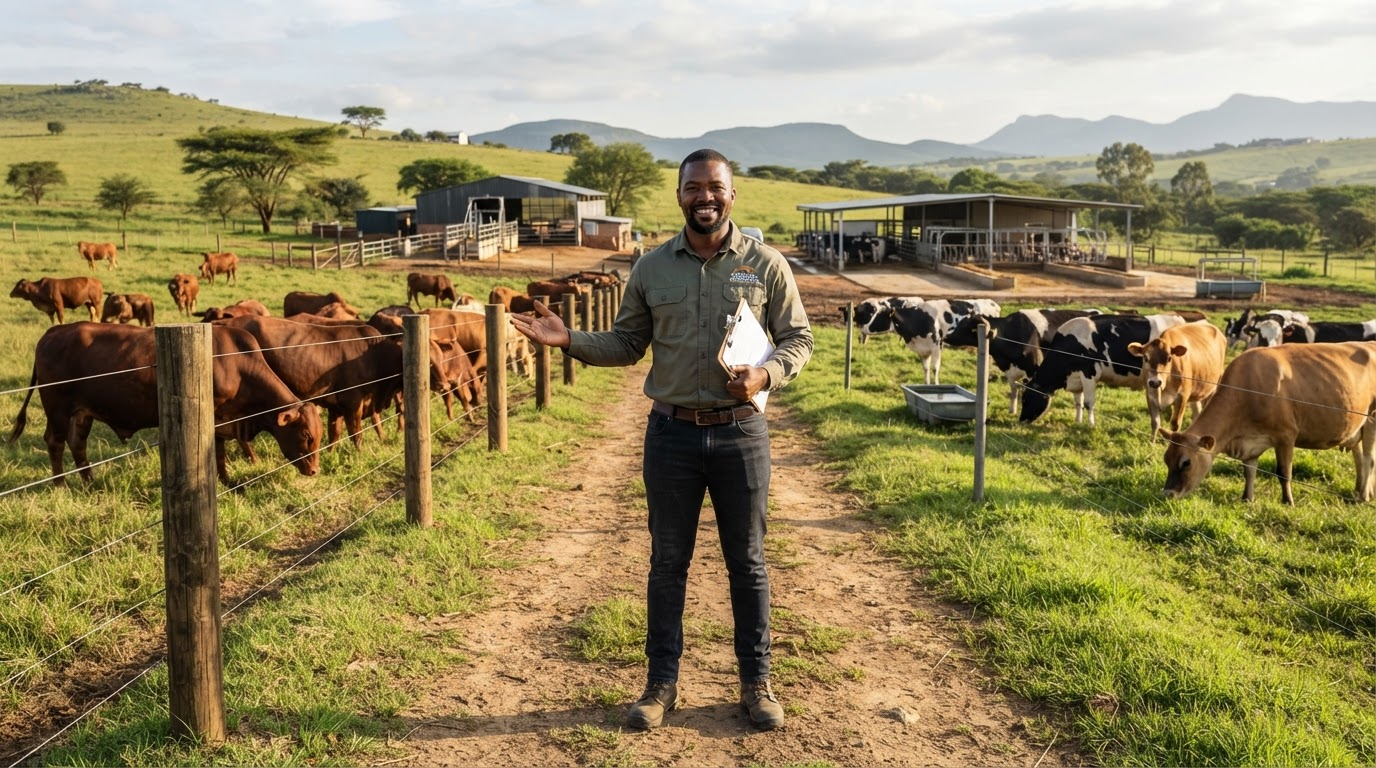
Category: Cattle & Dairy Farming | Agribusiness Comparison Guide
Introduction
Beef and dairy farming are two major cattle production opportunities in Africa.
Both can support commercial agribusinesses, but they differ in startup capital, income frequency, operating costs, labour requirements, production cycles and market risk.
The better enterprise depends on the farmer’s resources, location and business objectives. A farmer with extensive grazing land but limited daily labour may prefer a beef operation. A farmer with sufficient fodder, reliable milk buyers and a strong daily management system may find dairy farming more suitable.
1. Understanding Beef Farming
Beef production includes breeding calves for eventual sale, raising growing cattle, and buying cattle for fattening.
Revenue is generally received when animals are sold rather than every day.
Advantages include the potential to use extensive grazing systems and the ability to build a breeding herd gradually.
Challenges include long production cycles, livestock price fluctuations, drought exposure and capital tied up in animals.
2. Understanding Dairy Farming
Dairy farming generates revenue through the sale of milk produced by lactating
cows.
Milk sales may occur daily, several times weekly, or according to processor collection schedules.
Advantages include frequent potential income and opportunities to establish repeat buyer relationships.
Challenges include daily milking, consistent feed and water, milk hygiene, cooling requirements and the management of dry cows.
3. Beef vs Dairy Farming Comparison
Factor           Beef farming                  Dairy farming

Main product     Live cattle or beef animals   Milk

Income
                 Periodic livestock sales      Potentially frequent milk sales
frequency

Often higher for specialized
Startup costs    Significant
                                               facilities
Daily labour     Varies by system               Consistent milking and care

Grazing or intensive           Nutritionally demanding milk
Feeding
                 finishing                      production

Livestock traders, auctions,   Milk processors, cooperatives and
Market access
                 processors                     lawful direct buyers

Product          Live animals are not
                                                Milk is highly perishable
perishability    immediately perishable

Main financial Animal prices and slow           Feed costs, low milk prices and
risk             turnover                       spoilage

Production                                      Milk yields, breeding, health and
                 Breeding, weight and sales
records                                         costs

Beginner                                        Requires stronger daily
                 Often more flexible
suitability                                     management
4. Example: Five-Cow Beef Enterprise
Using the illustrative Article 83 business model:
Amoun
Financial measure
                              t

Initial investment            $5,150

Annual calf sales             $1,200

Annual cash operating
                              $900
expenses

Annual cash operating
                              $300
surplus
This model assumes a small breeding herd with four marketable calves during the year.
The $300 is not a full accounting profit or an investment return. 5. Example: Five-Cow Dairy Enterprise
Using the Article 86 scenario:
Financial measure                Amount

Initial investment               $12,000

1,440
Monthly saleable milk
                                 litres

Monthly milk revenue             $648

Monthly cash operating
                                 $475
expenses

Monthly cash operating
                                 $173
surplus
Multiplying the monthly surplus by twelve gives $2,076, but only if the same saleable milk output, costs and prices continue every month.
That assumption is often unrealistic because of dry periods, lactation changes and seasonal feeding costs.
These example enterprises also exclude some overheads and use different asset structures, so the figures should not be treated as a direct comparison of investment returns.
6. Which Requires More Capital?
Both businesses need livestock, water, feed and animal health services.
Dairy enterprises may require additional investment in milking equipment,
hygiene facilities, cooling and reliable electricity.

Beef breeding operations may require larger grazing areas and long periods
before receiving sales revenue.
A beef fattening business may also require considerable working capital to purchase animals and feed before sales.
7. Which Has Better Cash Flow?
Dairy farming can offer more regular income, assuming consistent production and reliable milk collection.
Beef breeding generally produces less frequent but potentially larger individual transactions.
Fattening operations may generate revenue after each production cycle.
The most suitable cash-flow pattern depends on household needs and available reserves.
8. Which Is More Suitable for Different African Regions?
Semi-arid regions
In many lower-rainfall farming areas, locally adapted beef cattle may be more practical than high-input dairy herds, particularly where irrigation and purchased feed are expensive.
Productive highland farming areas
Some highland locations with suitable temperatures, reliable fodder and strong milk markets may support specialized dairy farming.
Peri-urban areas
Farmers near large towns may have access to milk buyers, feed suppliers, transport and veterinary services.
However, land costs, waste management and milk safety requirements can be substantial.
10. Which Farming Model Should Beginners Consider?
Consider beef farming when land and grazing resources are available, buyers can be reached, and you can manage irregular sales income.
Consider dairy farming when milk buyers are dependable, suitable feed is available throughout the year, and daily milking and hygiene requirements can be met.
Consider cattle fattening when you have reliable sources of growing animals, affordable feed and a clear market for finished livestock.
Before committing substantial capital, prepare conservative financial scenarios that account for drought, animal illness and low selling prices.
Frequently Asked Questions
Is beef farming cheaper to start than dairy farming?
It can be, particularly where grazing and existing infrastructure are available. But intensive beef operations can also require significant capital.
Which is more profitable: beef or dairy?
Neither is automatically more profitable. Compare complete business costs, sales revenues, capital investment and operational risks under local conditions.
Can I combine beef and dairy farming? Yes, but a mixed enterprise requires careful breeding, feeding, infrastructure and marketing plans.
Is cattle farming a reliable side hustle?
A small beef herd may be manageable alongside other work if proper livestock care is arranged. Dairy generally demands more intensive daily attention.