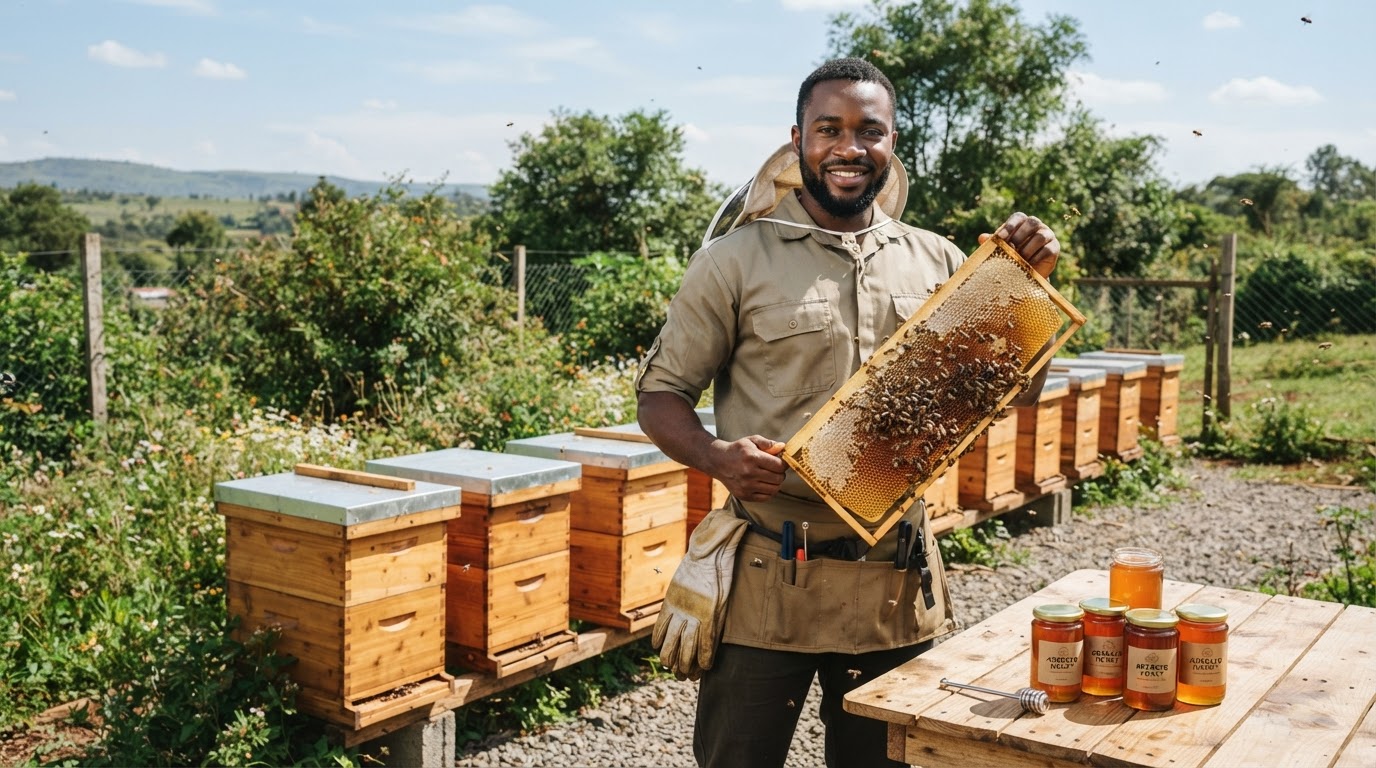
Category: Alternative Livestock & Aquaculture | Honey Profitability Guide
Introduction
Beekeeping profitability depends on the number of productive colonies, honey yield per hive, harvesting costs, packaging expenses and selling prices. The number of installed hives alone is not a reliable measure of annual production. Some hives may remain unoccupied, while colonies in other hives may produce little or no harvestable honey during a difficult season. A realistic business plan should account for these uncertainties.
1. Calculate Initial Beekeeping Investment
An illustrative ten-hive project might require:
| Startup expense | Estimated cost |
|---|---|
| Ten hives at $60 | $600 |
| Hive stands and site preparation | $150 |
| Protective suits | $150 |
| Smokers and hive tools | $100 |
| Honey extraction and filtering equipment | $200 |
| Food-grade containers | $100 |
| Colony establishment provision | $250 |
| Training, transport and contingency | $250 |
| Total startup investment | $1,800 |
This scenario excludes land purchase, major buildings and commercial processing machinery.
2. Estimate Honey Yield per Hive
Honey production varies with bee forage, colony strength, climate, management, pests and hive type. For planning purposes, consider three illustrative annual harvestable-yield scenarios.
| Scenario | Honey per productive hive annually |
|---|---|
| Low yield | 5 kg |
| Moderate yield | 10 kg |
| Higher yield | 20 kg |
These are hypothetical scenarios, not guaranteed yields or regional averages.
3. Account for Hive Occupancy
Suppose ten hives are installed but only eight contain productive colonies. With an assumed yield of 10 kg per productive hive, 8 × 10 = 80 kg. The estimated annual harvest would be 80 kg of honey.
4. Estimate Honey Revenue
If the 80 kg is sold at an assumed $6 per kg, 80 × $6 = $480. Annual gross revenue would be $480. A price received from wholesalers may differ from the price achieved through direct retail sales.
5. Estimate Annual Cash Operating Costs
| Expense | Estimated annual cost |
|---|---|
| Hive maintenance | $50 |
| Inspection and transport | $60 |
| Harvesting and processing supplies | $55 |
| Packaging and labelling | $70 |
| Marketing and delivery | $40 |
| Pest management and contingency | $45 |
| Total annual cash costs | $320 |
Illustrative operating surplus: $480 − $320 = $160. This is a $160 cash operating surplus before labour, depreciation, taxes, financing and recovery of initial capital. It would not justify assuming that a ten-hive project is already earning a substantial financial return.
6. Beekeeping Profit Calculator
A model should use the number of installed hives, percentage containing productive colonies, annual honey per productive hive, price per kg and annual cash operating costs:
- Productive hives = total installed hives × productive hive percentage.
- Annual honey production = productive hives × harvestable honey yield per productive hive.
- Gross sales revenue = honey produced × selling price per kilogram.
- Operating surplus or loss = revenue − annual cash operating costs.
Illustrative baseline: Ten installed hives, 80% productive, 10 kg per productive hive, $6/kg price and $320 operating costs = 80 kg harvested, $480 revenue and $160 operating surplus. The original interactive calculator is not represented as a nonworking embedded widget.
7. How Honey Prices Influence Profitability
Assume the farm produces 80 kg annually and incurs $320 in cash operating costs.
| Honey price per kg | Revenue | Cash surplus |
|---|---|---|
| $4 | $320 | $0 |
| $5 | $400 | $80 |
| $6 | $480 | $160 |
| $7 | $560 | $240 |
| $8 | $640 | $320 |
| $10 | $800 | $480 |
The original chart shows the effect of changing selling prices under fixed assumptions; it is not a statement of current African honey prices. The data are preserved in this editable table.
8. Additional Beekeeping Income Opportunities
Honey is not the only potentially marketable product. Depending on the farm’s capability and local regulations, additional opportunities may include:
- Beeswax sales.
- Beeswax-based manufactured products.
- Legitimate bee-colony or queen rearing.
- Pollination services.
- Training and apiary-related services.
Each opportunity requires its own market assessment and cost calculation.
9. Improve Honey Yield Sustainably
Maintain strong colonies
Monitor colony health and address pests appropriately.
Protect forage resources
Preserve flowering vegetation and work with neighbouring farmers to reduce harmful pesticide exposure.
Harvest responsibly
Avoid removing more honey than the colony can safely spare.
Reduce processing losses
Use appropriate equipment and containers to minimize contamination and waste.
Sell through reliable buyers
Compare wholesale and retail opportunities after accounting for packaging, transport and the time required to make sales. FAO guidance emphasizes good beekeeping practices and sustainable hive management for African small-scale beekeepers.
10. Consider Capital Recovery
With a $1,800 initial investment and an illustrative annual cash operating surplus of $160, the project would recover its initial capital slowly if performance remained unchanged. A simple calculation gives $1,800 ÷ $160 = 11.25 years. This is only a simplistic payback illustration. It excludes changing hive performance, asset replacement, inflation, taxes and the time value of money. Farmers should evaluate stronger and weaker scenarios before deciding whether to expand.
Frequently Asked Questions
How much honey can ten beehives produce?
Production depends on the number of productive colonies and yield per hive. The illustrative example produces 80 kg annually from eight productive hives.
Is beekeeping profitable with ten hives?
It can be, but profitability varies widely. Small apiaries may provide modest supplementary income rather than a full livelihood.
Is selling honey directly more profitable than wholesale?
Direct sales can achieve higher prices, but packaging, marketing, distribution and customer service increase costs.
How can I increase my beekeeping income?
Improve colony health, protect forage resources, reduce losses and develop dependable markets before expanding the number of hives.