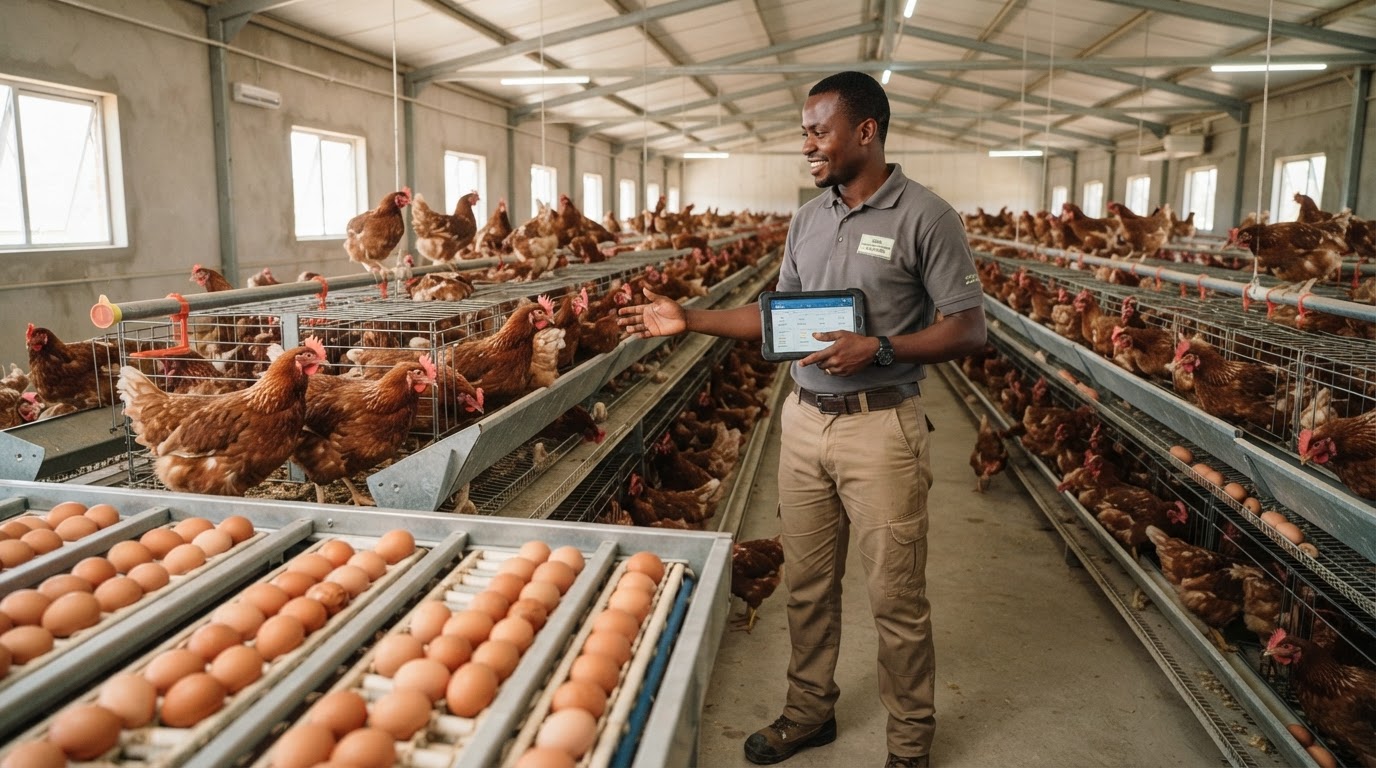
A 500-layer farm can supply hundreds of egg trays each month. At this scale, operating successfully requires more than feeding chickens: farmers need established sales channels, good recordkeeping, sufficient feed storage and reliable working capital.
How Much Capital Is Needed for 500 Layers?
The following model assumes 500 point-of-lay pullets.
| Startup expense | Illustrative USD |
|---|---|
| 500 pullets at $8.50 | $4,250.00 |
| Poultry house | $2,700.00 |
| Nesting, feeding and watering equipment | $800.00 |
| First month’s operating expenses | $1,507.50 |
| Initial cash requirement | $9,257.50 |
Add a contingency based on local operating risks. Ten percent of the modeled monthly operating budget would be about $151.
These figures are placeholders for business planning, not construction or poultry supplier quotations.
Housing Requirements for 500 Layers
Provide enough usable floor area for the birds and their management system, along with adequate nests, feeder and drinker access, ventilation, perches where appropriate and a separate area for egg handling.
A preliminary deep-litter design at five hens per square metre would require around 100 m² of usable bird floor area for 500 hens. This is only a layout
illustration; final space allowances must follow the selected breed, welfare standards, climate and system.
In hot regions, airflow, drinking-water reliability and stocking density must receive particular attention.
Monthly Feeding Requirements
At 110 g per hen daily:
500×0.110×30 = 1,650 kg
This equals 33 bags of 50 kg feed.
At $0.45/kg, the modeled monthly feed cost is $742.50.
Farmers should maintain purchase records and compare actual feed intake against the breed supplier’s guidance.
Monthly Operating Budget
| Expense | USD/month |
|---|---|
| Feed | $742.50 |
| Water and energy | $65.00 |
| Veterinary and health | $65.00 |
| Litter and cleaning | $60.00 |
| Packaging | $110.00 |
| Transport and marketing | $140.00 |
| Labour | $240.00 |
| Miscellaneous | $85.00 |
| Total | $1,507.50 |
The model assumes paid labour and excludes loan repayments, taxes, infrastructure depreciation and the separate pullet replacement allocation.
Expected Egg Production
At 82% hen-day production:
500×0.82×30 = 12,300 eggs
After a 3% allowance for unsaleable eggs:
12,300×0.97÷30 = 397.7 trays
At $5.50 per tray:
397.7×$5.50 = $2,187.35
Monthly operating surplus:
$2,187.35 − $1,507.50 = $679.85
The modeled flock-replacement allocation is $4,250 divided by 15 months, or $283.33 per month. That leaves approximately $396.52 after replacement allocation, before infrastructure depreciation, taxes, finance costs and other excluded expenses.
Compare Three Egg Price Scenarios
| Scenario | Production rate | Price/tray | Monthly revenue | Operating surplus |
|---|---|---|---|---|
| Conservative | 70% | $4.50 | $1,527.75 | $20.25 |
| Typical | 82% | $5.50 | $2,187.35 | $679.85 |
| Favourable | 90% | $6.50 | $2,837.25 | $1,329.75 |
The conservative scenario nearly eliminates the operating surplus, even before replacement and depreciation.
This shows why farmers should not rely on peak production or optimistic prices when assessing investment.
Marketing 500 Layers’ Eggs
At typical production, the farm generates approximately 398 saleable trays per month, or roughly 13 trays per day on average.
Potential customers include retailers, market traders, restaurants, grocery stores, bakeries and institutions.
Spread deliveries across several customers to reduce dependence on any single buyer.
FAQs
How many eggs can 500 layers produce daily?
At 82% average production, approximately 410 eggs before breakage and grading losses.
How many bags of feed do 500 layers need?
Approximately 33 bags of 50 kg feed in a modeled 30-day month.
Can 500 layers be managed as a side hustle?
Possibly, but someone must supervise the flock every day. Feed, water, egg collection and health checks cannot be postponed.
Is 500-layer farming profitable?
It may be, depending on real egg prices and costs. The typical example produces a monthly operating surplus of $679.85, not guaranteed net profit.