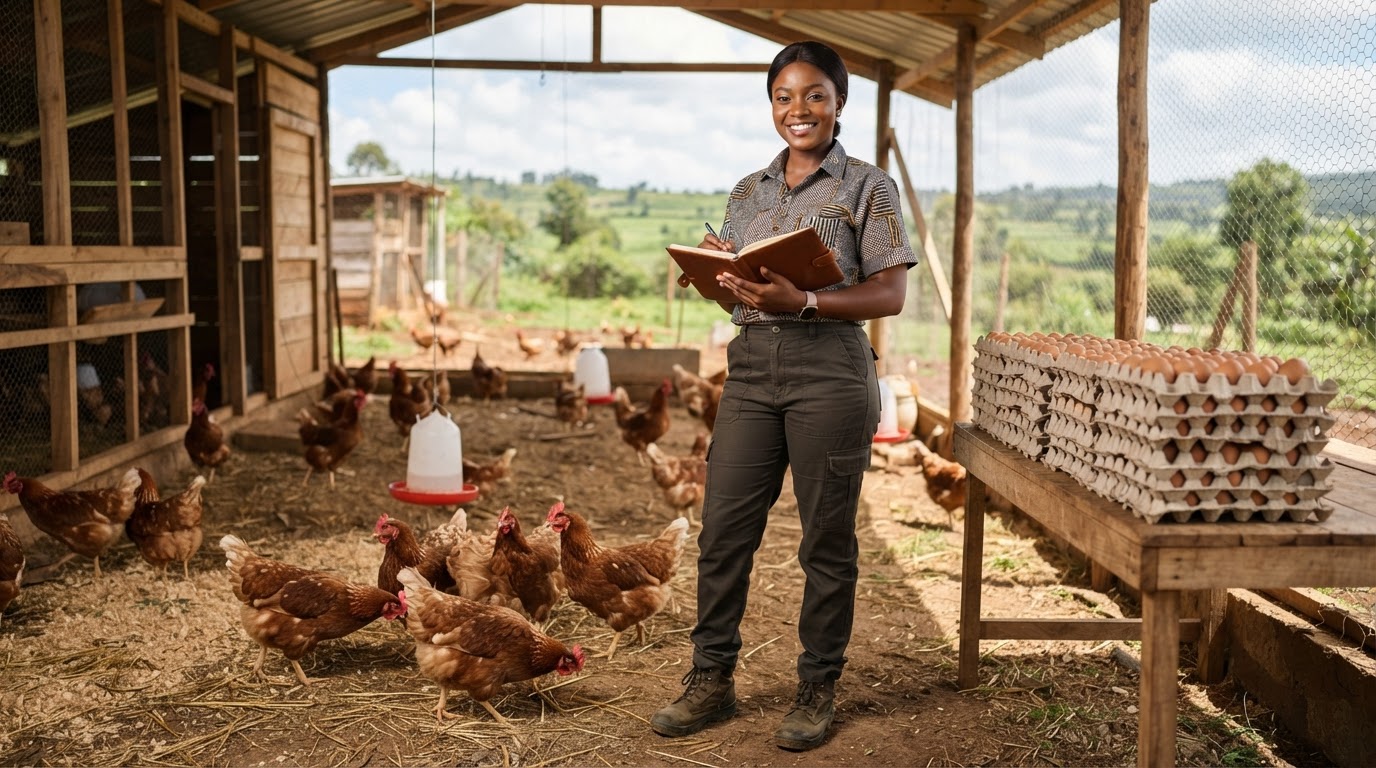
Starting with 100 layer chickens can help a new farmer understand egg production before investing in a larger enterprise. However, the business must
cover both the initial purchase of pullets and recurring expenses while the hens produce eggs.
Startup Budget for 100 Layers
This example assumes the farmer purchases 100 point-of-lay pullets, rather than raising day-old chicks.
| Startup expense | Illustrative USD |
|---|---|
| 100 pullets at $8.50 | $850.00 |
| Basic poultry house or conversion | $650.00 |
| Feeders, drinkers, nests and equipment | $250.00 |
| First month’s operating costs | $368.50 |
| Initial cash requirement | $2,118.50 |
The budget assumes access to land and an existing water and energy supply. It excludes land acquisition, major utility installation, financing and contingency reserves.
A 10% contingency on the estimated first month’s operating costs adds approximately $37.
Monthly Operating Expenses
| Expense | USD/month |
|---|---|
| Layer feed: 330 kg | $148.50 |
| Water and energy | $22.00 |
| Veterinary and health allowance | $18.00 |
| Litter, cleaning and maintenance | $16.00 |
| Egg trays and packaging | $24.00 |
| Transport and marketing | $35.00 |
| Labour | $75.00 |
| Miscellaneous | $30.00 |
| Total monthly operating costs | $368.50 |
How Much Feed Will 100 Layers Eat?
At 110 g per bird per day:
100×0.110×30 = 330 kg
That is 6.6 bags of 50 kg feed. Purchasing seven bags would provide 350 kg, with unused feed carried forward if stored safely.
Actual consumption depends on breed, feed energy concentration, weather, age and production performance. The 110 g figure is a planning assumption consistent with the range shown in commercial layer guidance, not a feeding prescription.
hylinesa.co.za
How Many Eggs Can 100 Layers Produce?
At an average 82% production rate:
100×82%×30 = 2,460 eggs
After deducting 3% unsaleable eggs, the farm has approximately 2,386 marketable eggs, equivalent to 79.54 trays.
At $5.50 per tray, modeled revenue is $437.47.
Subtracting $368.50 in operating expenses gives an operating surplus of $68.97.
That surplus is not the same as net profit. It does not yet account for infrastructure depreciation, the cost of replacing hens, financing or taxes.
Allow for Replacement Pullets
A layer business must eventually replace aging hens.
If the initial $850 pullet investment is allocated evenly over 15 production months:
$850÷15 = $56.67 per month
The example leaves approximately $12.30 per month after this replacement allocation, but before other excluded expenses.
Actual replacement timing and value depend on flock performance, mortality, sale proceeds from spent hens and market conditions.
Conservative, Typical and Favourable Scenarios
100-layer monthly egg revenue scenarios
Illustrative USD per 30 days, after 3% unsaleable eggs.
$0$150$300$450$600ConservativeTypicalFavourable
| Scenario | Hen-day rate | Tray price | Operating surplus/(loss) |
|---|---|---|---|
| Conservative | 70% | $4.50 | −$62.95 |
| Typical | 82% | $5.50 | $68.97 |
| Favourable | 90% | $6.50 | $198.95 |
All three scenarios hold operating expenses at $368.50 to isolate revenue effects. In actual farming, costs also vary.
How to Improve Financial Performance
Focus on dependable customers, correct feed storage, healthy hens, low egg breakage and reliable production records.
Reducing essential veterinary care or using nutritionally inadequate feed can cost more than it saves.
FAQs
Is $1,000 enough to start with 100 layers?
It may be possible with suitable existing housing and equipment, but it would not cover the $2,118.50 first-month cash requirement modeled here.
How many eggs will 100 layers produce daily?
At an 82% hen-day rate, the model averages 82 eggs a day. Actual daily totals fluctuate.
How much feed do 100 layers need monthly?
Approximately 330 kg under the model’s assumptions.
Do layers produce the same number of eggs throughout their lives?
No. Production changes with age, genetics, health, feeding, lighting and environmental conditions.