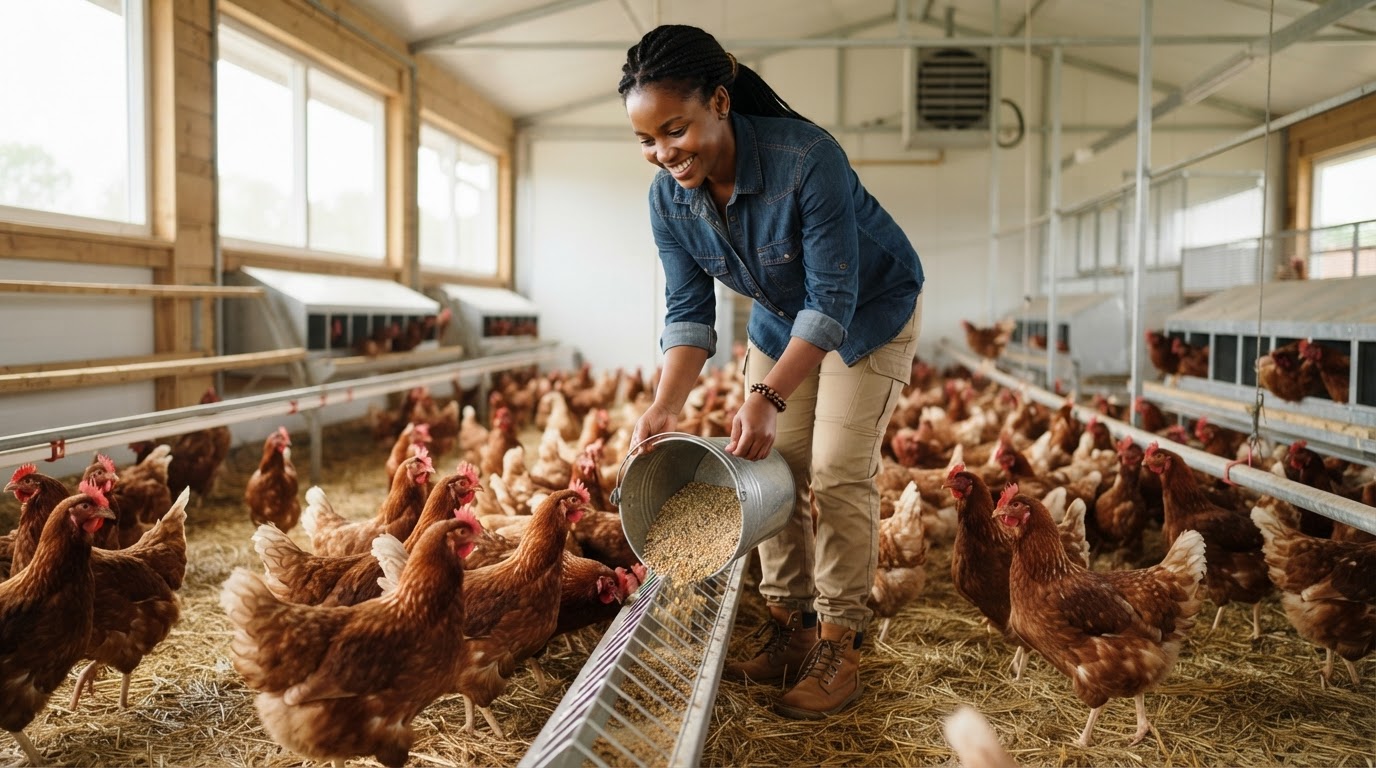
Feeding is one of the largest expenses in commercial egg farming. A balanced feeding programme helps hens develop properly, maintain body condition and produce eggs with acceptable shell quality.
Commercial layers have different nutritional needs as they grow, mature and begin laying eggs. Using the wrong ration can reduce production and increase farming costs.
Understanding Layer Feeding Stages
| Feeding stage | Approximate age | Main objective |
|---|---|---|
| Chick starter | First several weeks | Early growth and development |
| Pullet grower/developer | Growing period before maturity | Controlled, uniform development |
| Pre-lay | Short transition before laying | Prepare for egg production |
| Layer ration | From onset of lay | Support egg production and shell formation |
These stages are descriptive. Actual ration changes should follow the breeder’s programme, measured body weight and sexual maturity, rather than arbitrary dates.
Lohmann’s management guidance emphasizes the importance of correctly timing the transition from developer and pre-layer feeds to laying diets.
lohmann-breeders.com+1
Chick Starter Feed
Young chicks need a nutritionally balanced starter ration formulated for growing layer pullets, not simply a broiler fattening feed.
Provide clean drinking water immediately, protect feed from moisture and check whether chicks are eating normally.
Early management also includes appropriate brooding, ventilation and hygiene.
Grower and Developer Feed
During the growing stage, the goal is to produce healthy, uniformly developed pullets.
A bird that grows too slowly may enter laying with inadequate body reserves. Poor flock uniformity can also complicate feeding and lighting management.
Weigh representative birds and compare the results with the selected strain’s growth targets.
Avoid substituting maize alone for a balanced ration.
Pre-Lay Feeding
The pre-lay phase helps prepare pullets for the physiological demands of egg production.
It must be managed carefully because immature birds and actively laying hens have different mineral requirements.
Follow supplier guidance on when pre-lay feed is appropriate and when the flock should transition to its first layer diet.
Layer Feed and Calcium Requirements
Laying hens need suitable protein, amino acids, energy, calcium and phosphorus for egg formation and maintaining health.
Calcium is particularly important for eggshell formation, but adding minerals indiscriminately can produce an unbalanced diet.
Commercial feed should be selected according to the flock’s age, feed intake, egg mass and housing conditions. A qualified poultry nutritionist should assess homemade formulations.
How Much Feed Do Layers Need?
Using the FarmUP planning rate of 110 g per hen per day:
| Flock | Daily feed | 30-day feed | 50 kg bags |
|---|---|---|---|
| 100 | 11 kg | 330 kg | 6.6 |
| 500 | 55 kg | 1,650 kg | 33 |
| 1,000 | 110 kg | 3,300 kg | 66 |
These figures represent the laying stage, not the cumulative feed needed to rear chicks to point-of-lay age.
How to Reduce Feed Wastage
Keep feeders properly adjusted and prevent hens from scattering feed onto litter.
Store feed in dry, pest-resistant conditions, off the floor and away from rain.
Record feed purchased, feed issued and remaining stock each week. Investigate unexpected changes in consumption.
Feeding Layers During Hot Weather
High temperatures may reduce feed consumption and compromise production.
Provide ample clean drinking water, adequate airflow and shade. Review housing conditions and feeding practices with an extension officer or poultry adviser.
Do not attempt to manage heat stress by withholding water.
FAQs
Can layer chickens eat broiler feed?
Broiler rations are formulated for different production objectives. Use feed appropriate to the bird’s stage and obtain professional advice before substituting diets.
How much feed does one layer eat daily?
The FarmUP model uses 110 g, but actual intake varies by strain, age, temperature, ration and production.
Can maize alone support egg production?
No. Maize does not supply all the nutrients required for sustained commercial egg production.
Why are my hens eating less?
Possible causes include heat, feed quality, water problems, stress and illness. Persistent changes warrant veterinary assessment.
Resources: Lohmann Layer Nutrition Guidance · FAO Small-Scale Poultry Nutrition