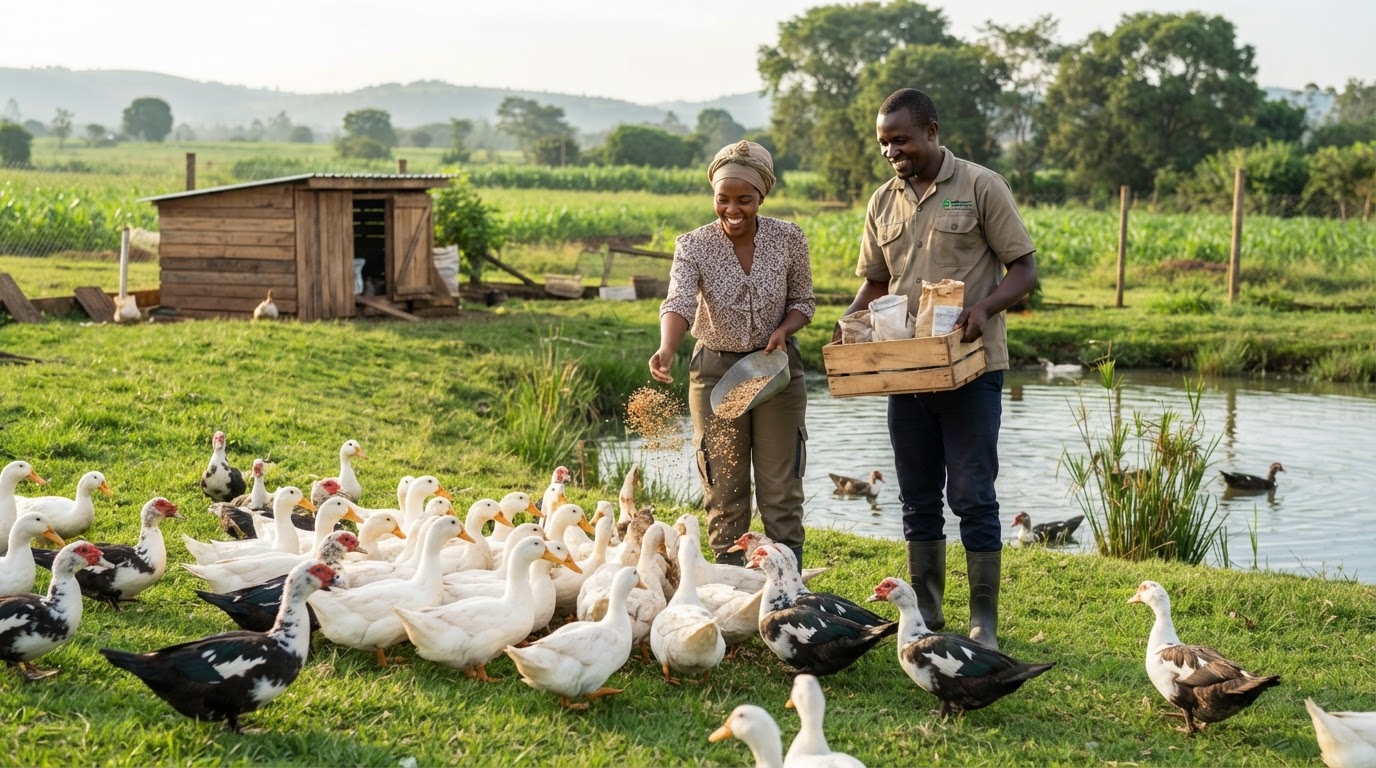
Category: Alternative Livestock & Aquaculture | Duck Meat & Egg Farming
Introduction
Duck farming offers opportunities to produce meat, eggs and breeding stock for African markets. Duck enterprises may complement other small-scale farming operations, especially where appropriate housing, feed supplies and markets are available. However, ducks require careful water and litter management. Wet, poorly maintained housing can contribute to sanitation problems and disease.
1. Choose Your Duck Farming Business Model
Farmers may raise ducks primarily for meat, eggs or breeding. Meat production requires a reliable market for finished birds, while egg production requires suitable laying breeds and consistent egg buyers. Research local preferences before selecting breeds.
2. Popular Duck Types
Pekin Ducks
Commonly associated with commercial meat production.
Muscovy Ducks
Raised for meat in many smallholder farming systems. Indian Runner ducks and some other laying-oriented types may be evaluated for egg production. Local adaptations and actual breeder quality matter more than breed labels alone.
3. Prepare Suitable Housing
Duck housing should provide ventilation, predator protection, shade, dry resting areas and access to clean drinking water. Ducks need water arrangements that allow normal drinking and cleaning behaviour, while minimizing standing water in their housing. A swimming pond is not essential for every commercial production system, but watering equipment must support duck welfare and hygiene.
4. Example Startup Budget for 50 Ducks
Illustrative USD meat-production scenario.
| Expense | Estimated cost |
|---|---|
| 50 ducklings | $125 |
| Housing improvements | $200 |
| Feed for one production cycle | $280 |
| Feeders and drinkers | $70 |
| Bedding and sanitation | $35 |
| Veterinary and biosecurity provision | $40 |
| Transport and marketing | $60 |
| Contingency | $90 |
| Total | $900 |
This includes some startup equipment and assumes an existing sheltered structure.
5. Feed Ducks Appropriately
Growing ducks require balanced feed suited to their development stage. Avoid spoiled feed and check feed formulations with a poultry nutrition specialist, particularly if substitute feeds are being considered. Provide dependable fresh water alongside feeding facilities.
6. Calculate Potential Revenue
Suppose 50 ducklings are raised and 46 reach sale condition. If each finished duck sells for an illustrative $18, 46 × $18 = $828. Against the $900 startup and cycle budget, $828 − $900 = −$72. This example does not recover the full first-cycle investment. Subsequent cycles may cost less if suitable housing and equipment are reused, but feed and duckling costs must still be covered.
7. Disease Prevention and Biosecurity
Ducks can be affected by avian influenza and other infectious poultry diseases. Avoid unnecessary contact between farm ducks, wild waterbirds and other poultry. Maintain sanitation, isolate incoming stock appropriately and seek veterinary advice on local disease-control measures. WOAH poultry biosecurity guidance addresses risks associated with poultry premises, wild birds, visitors and animal movements.
8. Regional Considerations
Duck production conditions differ across Africa. In regions with seasonal heavy rainfall, drainage and housing management are especially important. In drier locations, water supply and heat protection should receive more attention.
9. Marketing Ducks
Potential buyers include households, restaurants, hospitality businesses, specialty butcheries and live-bird traders. Confirm whether buyers require live birds, slaughtered birds or processed products. Ensure that transport, slaughter and food-handling arrangements comply with local regulations.
Frequently Asked Questions
Is duck farming profitable in Africa?
It can be, but profitability depends on feed costs, survival, growth and buyer demand.
Are Muscovy or Pekin ducks better?
The choice depends on the production purpose and local market.
Do ducks need a pond to survive?
They need suitable access to drinking water and water for normal cleaning behaviours, but not every farm requires a large swimming pond.