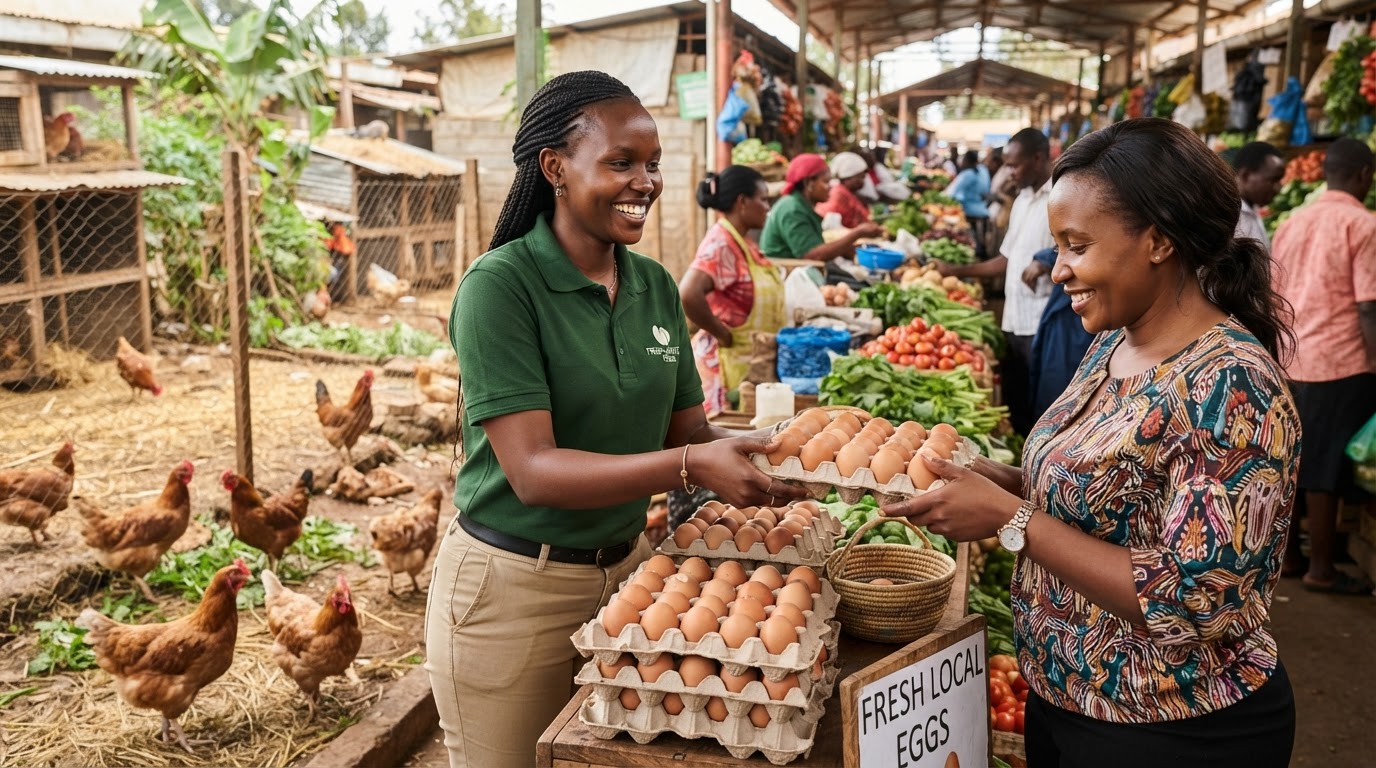
Producing eggs consistently does not automatically create a profitable business. Farmers also need customers who purchase the eggs at sustainable prices and pay reliably.
A strong egg marketing strategy begins before the hens reach peak production.
Understand Your Potential Egg Markets
| Buyer | Potential advantage | Important consideration |
|---|---|---|
| Households | Direct relationships and repeat orders | Smaller quantities and delivery time |
| Grocery shops | Regular local demand | Retailer margins and payment terms |
| Market traders | Ability to move larger quantities | Negotiated wholesale pricing |
| Bakeries | Repeat ingredient purchases | Consistent supply and quality |
| Restaurants and hotels | Regular food-service demand | Delivery and food-safety requirements |
| Schools and institutions | Potential bulk orders | Procurement requirements and payment delays |
| Supermarkets | Larger distribution opportunities | Grading, packaging, documentation and returns |
Different buyers require different egg sizes, grades, packaging and delivery arrangements.
Check local food-safety, egg grading, transport and labelling rules before approaching formal retail chains.
Step 1: Research Egg Prices in Your Area
Visit local markets, shops and commercial buyers to compare selling prices.
Ask about the difference between farmgate, wholesale and retail prices.
Record prices by egg grade and tray size rather than comparing unlike products.
A retailer offering $6.00 per tray may not be more profitable than a nearby wholesale buyer paying $5.50 if the retail sale requires substantial delivery, packaging or credit costs.
Step 2: Estimate Your Expected Supply
Using the typical FarmUP model:
| Flock | Marketable tray equivalents/month | Average daily equivalent |
|---|---|---|
| 100 layers | 79.54 | 2.65 |
| 500 layers | 397.70 | 13.26 |
| 1,000 layers | 795.40 | 26.51 |
Actual daily output changes throughout the flock’s production life.
Develop a customer plan based on realistic average supply rather than assuming every hen will lay daily.
Step 3: Find Your First Buyers
Start by visiting grocery stores, bakeries, restaurants and produce traders within a manageable delivery radius.
Introduce your farm, explain the products you expect to supply and ask about purchasing requirements.
Use WhatsApp Business, community groups and local social media networks to share accurate product information and coordinate orders.
Do not present expressions of interest as confirmed purchases.
Step 4: Develop a Weekly Delivery Schedule
For a 500-layer business, approximately 398 monthly tray equivalents means an average of about 93 trays per seven days.
A farmer might seek several repeat buyers with staggered deliveries across the week.
Maintain backup customers for periods when orders are lower than expected.
Step 5: Negotiate Clear Payment Terms
For each buyer, confirm the following:
• Egg grade, quantity and packaging.
• Unit price and any delivery fee.
• Delivery or collection schedule.
• Responsibility for broken eggs and rejected stock.
• Payment date and acceptable payment method.
Written orders can help reduce disputes, particularly for larger customers.
Avoid extending more credit than the business can support.
Step 6: Protect Egg Quality
Collect eggs frequently, handle them carefully and follow local hygiene, storage and temperature-control requirements.
Separate cracked, leaking or otherwise unsuitable eggs from saleable stock and follow applicable food-safety disposal rules.
Record eggs delivered, accepted, rejected, returned and paid for.
Step 7: Build a Recognisable Egg Brand
A simple farm name, clean packaging, accurate grading and consistent communication can help customers recognise your products.
Professional service may be more valuable over time than chasing occasional customers offering slightly higher prices.
Example Buyer Prospecting Plan
These figures are outreach targets, not confirmed sales.
| Buyer category | Prospects to approach | Objective |
|---|---|---|
| Grocery shops | 10 | Establish regular orders |
| Bakeries | 5 | Understand weekly requirements |
| Restaurants | 5 | Explore repeat deliveries |
| Egg traders | 5 | Secure backup wholesale outlets |
| Institutions | 3 | Learn procurement requirements |
A farmer should adjust the plan to the actual volume and accessibility of their local market.
FAQs
Where can I sell eggs from 100 layers?
Possible customers include neighbours, households, grocery shops, small restaurants and market traders.
Who buys eggs in bulk?
Wholesalers, distributors, retailers, hotels, bakeries and institutions may purchase larger quantities, depending on their requirements.
Can I sell eggs through WhatsApp?
Yes, where local laws and platform rules permit. It can be useful for enquiries, orders and communicating collection arrangements.
Should I sell eggs on credit?
Credit sales introduce payment risk. Consider written terms, customer history and your working-capital needs.
Is wholesale or retail more profitable?
Either may produce better net returns depending on actual prices, transport, packaging, labour, unsold stock and payment risk.
Resource: FAO Poultry Production and Management